Working Capital Is CFOs' #1 Priority — And Most SMEs Aren't Equipped to Manage It
Q1 just closed. Do you know your exact cash position?
If the answer takes more than 24 hours to produce, you're running your business on delayed information — and you're not alone. But you are behind.
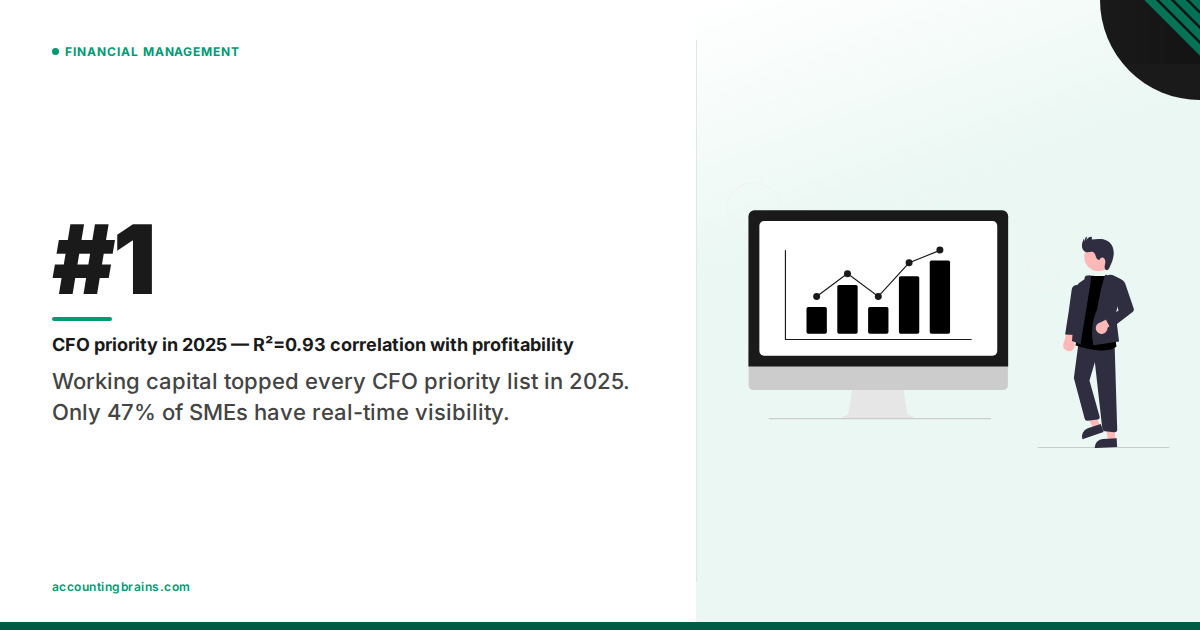
Working capital management topped the list of finance priorities in 2025, according to the Hackett Group. Not revenue growth. Not cost reduction. Not digital transformation. Cash flow visibility and working capital optimization. Because without it, everything else becomes unstable.
Why Working Capital Became Priority #1
The shift happened for a clear reason: interest rate volatility, extended payment terms, and supply chain unpredictability made cash flow management the single most consequential financial activity for operating businesses.
Academic research confirmed what experienced CFOs had long observed: working capital management has an R² of 0.93 correlation with SME profitability. That's not a modest relationship — it's the strongest predictor of financial health that research has identified. Working capital isn't a treasury function. It's the operating heartbeat of the business.
For businesses in the $2M to $50M revenue range — the segment that most commonly lacks dedicated financial leadership — poor working capital management isn't just inefficient. It's existential. Cash-strapped businesses can't invest in growth, can't negotiate with suppliers from strength, and can't survive the unexpected.
The Visibility Gap
Here's the operational reality: 47% of SMEs now use bank-integrated cash management tools that provide real-time cash visibility. The other 53% are making decisions based on yesterday's balances, last week's bank statements, or monthly financial reports that are weeks old by the time they're reviewed.
The firms in the 53% are making credit decisions, investment decisions, and operational decisions with a fundamental information disadvantage. When a payment is delayed by a major customer, they find out through the bank statement, not a real-time alert. When cash is sitting idle in accounts instead of being swept to higher-yield instruments, they find out at month-end, not daily.
Real-time cash visibility changes decision-making across the entire organization:
- Vendor payment timing gets optimized around actual cash availability, not estimated balances
- Credit line draws happen when they're needed, not as precautionary measures based on uncertainty
- Supplier discount opportunities (often 2% for early payment) can be captured systematically
- Customer credit terms get calibrated to the firm's actual cash conversion cycle
The Three Numbers That Matter Most
Working capital management comes down to three metrics that, together, define your cash conversion cycle — the time between spending cash to produce your product or service and collecting cash from your customers.
Days Sales Outstanding (DSO): How long does it take to collect after invoicing? Every day of DSO above your industry benchmark represents cash tied up in receivables. For a $10M company with 45-day DSO when the benchmark is 30 days, that's $410,000 in unnecessary cash tied up in the receivables pipeline.
Days Payable Outstanding (DPO): How long does it take to pay suppliers? Strategic management of DPO — paying at the optimal point in your payment terms — keeps cash working in the business longer. Many SMEs pay early because it feels responsible. It often isn't, from a cash flow perspective.
Inventory Turns: For product businesses, how fast does inventory convert to cash? Slow-moving inventory is frozen working capital. Companies that optimize inventory turns free up cash without needing additional credit.
Top-performing CFOs obsess over these three numbers because they're controllable, they're measurable, and improving them generates cash without raising prices or cutting costs.
What CFO-Level Visibility Actually Looks Like
The gap between SMEs with and without CFO-level financial management shows most clearly in working capital:
With CFO-level oversight:
- 13-week rolling cash flow forecasts updated weekly
- Automated alerts when DSO exceeds targets by customer
- Payment term optimization across the supplier base
- Credit line management tied to actual cash flow cycles
- Variance analysis between forecast and actual cash position
Without CFO-level oversight:
- Monthly bank reconciliations as the primary cash visibility tool
- Collections triggered by overdue notices, not proactive aging management
- Vendor payments managed by accounts payable without strategic timing
- Credit lines drawn as precautionary measures, not cash-flow-optimized instruments
- Cash crises discovered when balances are already critical
The cost of that gap is real. Businesses that optimize working capital through CFO-level management consistently outperform peers on profitability, growth rate, and resilience to economic disruption.
The Fractional CFO Answer for SMEs
Full-time CFO cost exceeds $265,000 annually before overhead — a number that puts dedicated financial leadership out of reach for most businesses doing under $20M in revenue. But the need for working capital management doesn't disappear because the salary budget can't support it.
Fractional CFO services deliver the same strategic financial capability — cash flow forecasting, working capital optimization, banking relationship management, board-ready reporting — at $3,000-$10,000 per month. For the SME that needs CFO-level thinking but can't justify the headcount cost, fractional is the structural solution.
The ROI case is direct: if fractional CFO engagement improves DSO by 10 days for a $5M revenue company, that's approximately $137,000 in cash unlocked from the receivables cycle. At $6,000/month for fractional services, the math resolves within the first quarter.
Multi-Country Complexity
For businesses operating across the USA, Canada, UAE, and Australia, working capital management adds jurisdictional complexity that amplifies the need for sophisticated financial oversight.
Currency fluctuations between CAD/USD, AED, and AUD create working capital volatility that doesn't exist in single-currency businesses. Payment terms and collection practices vary significantly by country — UAE businesses typically operate on longer payment cycles than US clients. Australian GST timing creates cash flow patterns that require specific management.
Multi-country businesses flying blind on working capital aren't just inefficient. They're exposed to currency risk, delayed collections, and cash flow surprises that a single-currency business doesn't face. CFO-level management becomes disproportionately valuable as geographic complexity increases.
The Post-Q1 Assessment
Q1 just closed. If your business or your clients' businesses don't have answers to these three questions within 24 hours of quarter-end, the working capital infrastructure isn't where it needs to be:
- What is the exact cash position as of March 31?
- What is the current DSO, and how does it compare to 90 days ago?
- What does the 13-week cash flow forecast look like?
These aren't advanced questions. They're the baseline of financial management that CFO-level oversight delivers. The businesses that can answer them have a structural advantage over those that can't.
Cash is king. But visibility is the kingdom.
Ready to transform your accounting? Contact Accounting Brains
Tags:
Need Professional Accounting Help?
Our CPA team is ready to help your business succeed