Why SMEs Need a Fractional CFO: The Numbers Say You Can't Afford Not To
Most small business owners know they need better financial leadership. They feel it every time they struggle to explain why cash is tight despite a profitable quarter. They feel it when investors ask for projections they can't produce. They feel it when a vendor asks about payment terms they've never modeled.
What they don't know is that the solution exists — and it's far more affordable than they think.
The Silent Killer: Cash Flow
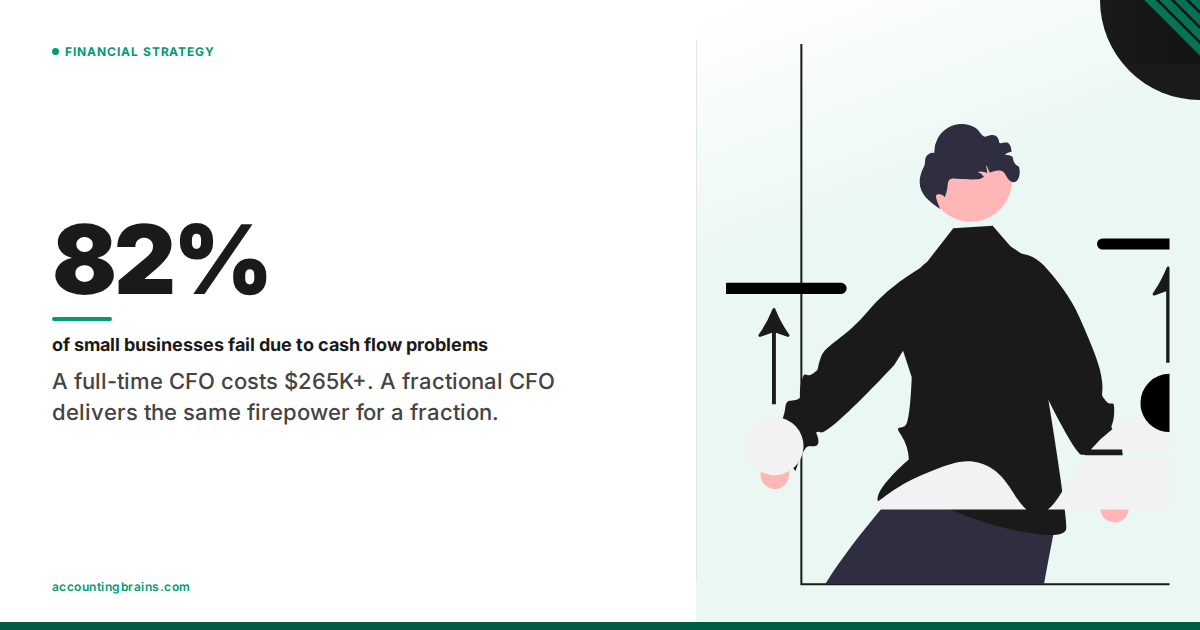
82% of small business failures trace back to cash flow problems (U.S. Bank Small Business Survey, 2025).
Not competition. Not bad products. Not economic downturns. Cash flow. The number one killer of small businesses is a problem that a strategic finance leader solves on day one — yet most SMEs don't have one.
Think about what that means in practice. A business can have strong revenue, happy customers, and a product the market loves — and still fail because cash comes in too slowly, goes out too fast, or because leadership can't see the gap forming until it's already a crisis.
That's not a revenue problem. That's a visibility problem.
60% of SMEs Are Struggling Right Now
The 82% failure rate sounds like a long-term risk. But the current reality is just as urgent: 60% of SMEs are actively struggling with cash flow today (PYMNTS Intelligence & American Express, 2025).
Six in ten small businesses are right now fighting delayed customer payments, unclear margin pictures, and spending blind spots they can't fully see. This isn't a warning about a future risk. It's the reality of the majority of businesses operating in North America, the UK, Australia, and beyond.
The ones that aren't struggling? They have financial leadership. Someone who watches the cash conversion cycle. Someone who spots the pattern three months before it becomes a problem.
The Full-Time CFO: Priced Out of Reach
Here's where most SME owners hit a wall: the average full-time CFO costs $265,000+ per year (Robert Half 2025 Salary Guide) — before benefits, equity, and overhead.
For a business doing $2M–$20M in annual revenue, that's not a hire. That's a fantasy. So books stay with someone who's good at compliance but blind to strategy. Financial decisions get made on gut feel. And the business keeps running blind on the metrics that actually determine survival.
The talent is too expensive. The alternative — doing without — is dangerous. For years, most SMEs were stuck in this impossible position.
Same CFO Brain. 80% Less Cost.
The fractional CFO model solved this problem.
A fractional CFO delivers $265K-level strategic thinking for $3,000–$10,000 per month. They're typically experienced finance executives — former CFOs or VPs of Finance — who work with multiple clients simultaneously, spreading their senior-level expertise across organizations that couldn't otherwise afford it.
What they deliver is identical to a full-time hire:
- Cash flow forecasting: Know your cash position 90 days in advance, not 30 days after a crisis
- Margin analysis: Understand which revenue lines actually drive profit
- Scenario modeling: Know what happens to your business under different conditions
- Fundraising prep: Build the financial story investors need to say yes
- Board-ready financials: Present with confidence, not apology
The only difference? You're not paying for holidays, benefits, equity, office space, or the weeks each year a full-time executive isn't at peak productivity. You pay for the outcomes.
The Market Has Already Moved
This isn't a new idea. Fractional CFO demand surged 310% since 2020 (LinkedIn Jobs on the Rise, 2026). The fractional finance workforce doubled from 60,000 to 120,000 professionals in just two years.
Businesses across the US, Canada, UAE, and Australia have already discovered that fractional financial leadership isn't a compromise. It's an upgrade. You get the same caliber of thinking as a Fortune 500 CFO — applied specifically to the problems of a growing SME, for a fraction of the cost.
And the growth isn't slowing. As the talent market tightens and the cost of full-time senior hires keeps rising, fractional models become more attractive, not less.
Who Needs a Fractional CFO Right Now?
The fractional CFO isn't for every business at every stage. But you likely need one if:
Your revenue is between $1M and $30M. You're too big to operate without financial strategy, too small to justify a $265K full-time hire.
You're growing fast. Fast growth creates cash flow complexity that a bookkeeper alone can't navigate. Payroll grows before revenue catches up. Inventory builds before sales convert. A CFO sees this before it becomes a crisis.
You're approaching a capital event. Fundraising, acquisition, or credit facility negotiations all require CFO-level preparation. Going in without it costs you terms.
You can't explain your numbers. If you couldn't walk an investor through your margin structure, your cash conversion cycle, and your 12-month forecast today — you need help.
Tax season feels strategic, not tactical. The best businesses use tax season to make forward-looking decisions, not just file returns. That requires CFO thinking.
The Accounting Brains Approach
At Accounting Brains, we support fractional CFO arrangements with the operational backbone they need to succeed. Our India-based accounting teams handle the bookkeeping, reconciliation, month-end close, and financial reporting — giving your fractional CFO clean, current data to work from on day one.
We serve businesses across the US, Canada, UAE, and Australia — delivering 40–60% cost efficiency versus building an equivalent team locally. Our 70+ clients and 98% retention rate reflect what happens when the right operational structure meets the right strategic leadership.
The combination works: affordable outsourced accounting operations + fractional CFO strategy = the finance function your business actually needs.
Ready to transform your accounting? Contact Accounting Brains
Tags:
Need Professional Accounting Help?
Our CPA team is ready to help your business succeed