Tax Season Burnout Is Breaking CPA Firms — And the Numbers Prove It's Getting Worse
Every spring, the same story plays out across accounting firms from New York to Los Angeles. Partners push their teams harder. Staff work nights and weekends. Quality checks get rushed. And somewhere in the middle of it all, a talented junior accountant quietly updates their LinkedIn profile.
Tax season burnout isn't new. But what's changed is the scale — and the data that now proves it's structural, not personal.
99% Burnout: This Is Now Universal
When nearly every single accountant in your profession reports burnout, that's not a people problem. That's a systems problem.
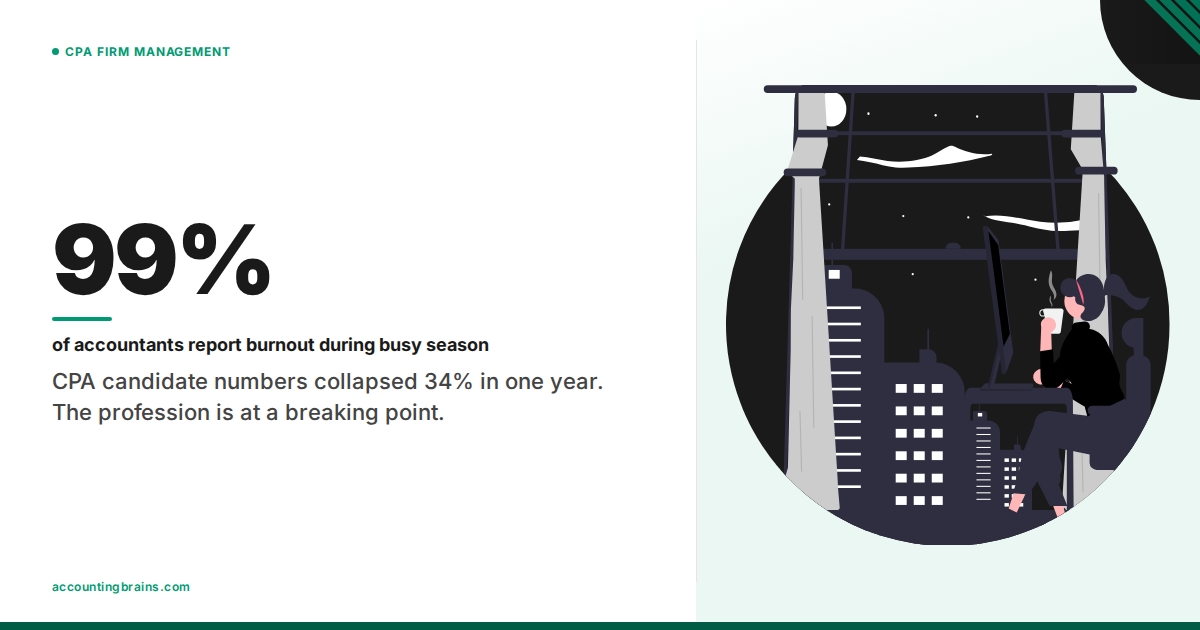
99% of accountants report burnout (FloQast Accounting Burnout Survey, 2025). Not stress. Not fatigue. Burnout — the clinical state of emotional and physical depletion that leads to disengagement, errors, and departure.
The accounting profession built a delivery model where work compresses into brutal 10-week sprints every January through April. The model worked when there was an unlimited supply of accountants willing to accept those conditions. That supply has run out.
What we're left with is a profession where essentially everyone is burning out — and the consequences are now measurable.
The Pipeline Is Collapsing, Not Just Shrinking
The instinct when facing a talent shortage is to hire. But you can't hire from a pipeline that's collapsing.
CPA candidates dropped 34% in a single year: from 42,626 new candidates in 2023 down to just 28,082 in 2024 (AICPA 2025 Trends Report). That's not a gradual decline. That's a collapse.
Young people considering accounting careers are watching the profession. They see the burnout. They see the 60-hour weeks. They see the peers who left for better-balanced roles in adjacent fields. And they're choosing differently.
The pipeline that accounting firms have always relied on to replace departing staff is no longer flowing at the volume the profession needs. This isn't a temporary blip from pandemic disruptions — it's a sustained structural shift in career choices.
The Hiring Market: 73 Days and Counting
Even if the pipeline were flowing, the competition for available talent has become brutal.
83% of finance leaders report they can't find qualified accounting talent (CFO Pulse Survey, 2025) — up from 70% just two years ago. The profession has moved from "tight talent market" to "near-impossible hiring environment" in less time than most firms have adapted.
When a position does open, firms aren't measuring weeks to fill. They're measuring months. It now takes 73 days on average to fill a CPA-required role — 41% longer than non-CPA positions. And qualified candidates in this market receive multiple offers within 10–14 days of starting their search.
If your hiring process takes six weeks — interviews, decisions, paperwork, offers — the best candidate has already accepted elsewhere before you've made a decision.
What Overwork Actually Costs: Beyond the Person
The overwork statistics are easy to dismiss as someone else's problem. They become harder to dismiss when you see the business consequences.
48% of accountants work 51–60 hours per week during busy season. Another 19% push past 70 hours. At these levels, cognitive performance deteriorates. Error rates climb. The quality review processes that should catch mistakes get rushed.
And the client consequences are real. Rushed work generates rework. Errors that should have been caught before filing become client conversations after filing. Trust erodes. Clients who start looking elsewhere rarely come back.
The costs cascade: rework costs, partner review time, client relationship management, potential liability exposure. The real cost of overwork isn't paid by the employee alone — it's paid by the firm in quality, reputation, and client retention.
Why Winning Firms Are Building Systems, Not Sprinting
The firms that come out of every busy season ahead aren't the ones who sprinted hardest. They're the ones who built year-round delivery capacity that doesn't depend on heroic individual effort in Q1.
The market has spoken clearly about where this is headed: the F&A outsourcing market is projected to hit $81 billion by 2030, growing at 8.2% annually (Mordor Intelligence, 2025). The investment flowing into outsourced accounting capacity isn't speculative — it's the profession's structural response to a talent market that can no longer meet demand.
The firms winning today have made a fundamental shift: they've separated routine compliance work from the capacity of their in-house team. By offloading bookkeeping, tax preparation support, and month-end close to specialized outsourced teams, they've achieved two things simultaneously:
- Absorbed seasonal volume without burning out in-house staff
- Freed partner and senior time for the advisory work that commands premium fees
Building for Year-Round Capacity
The accounting profession's busy season problem is, at its core, a capacity problem. You can't solve a capacity problem by working harder during the capacity crunch. You solve it by expanding capacity before it matters.
Outsourced accounting teams in India and other offshore centers have become the capacity solution that the profession needs. At Accounting Brains, we serve CPA firms across the US, Canada, UAE, and Australia as exactly that — year-round delivery capacity that absorbs seasonal spikes without touching your in-house team's bandwidth.
Our clients don't sprint through tax season with a skeleton crew running on caffeine and overtime. They operate with a structured workflow where trained remote teams handle the volume, and in-house partners focus on client relationships and complex advisory work.
The firms that build this structure today will be the ones still standing — and growing — when the talent market gets even tighter.
Ready to transform your accounting? Contact Accounting Brains
Tags:
Need Professional Accounting Help?
Our CPA team is ready to help your business succeed