Tax AI Went From 9% to 41% in One Year: Is Your Accounting Firm Keeping Up?
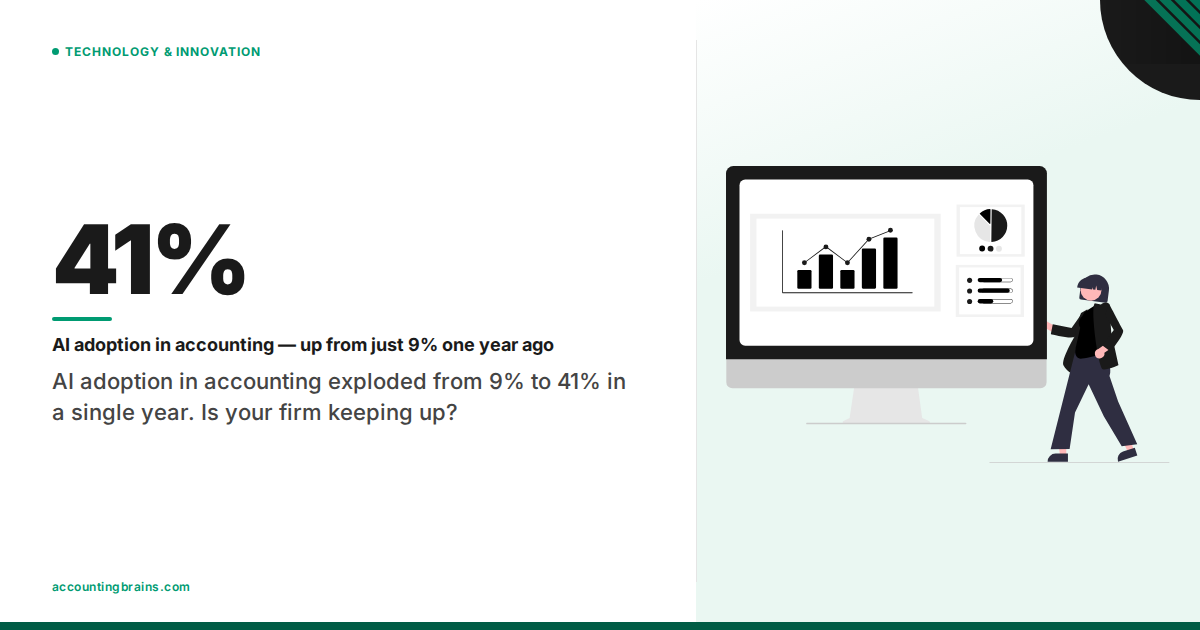
One year ago, AI adoption in accounting was still considered an early-adopter move. Nine percent of accounting firms were using it in any meaningful way. The other 91% were watching, evaluating, or skeptical.
That was twelve months ago.
Today, the landscape looks completely different — and the gap between firms that moved and firms that didn't is already producing measurable competitive consequences.
From 9% to 41% in Twelve Months
The speed of AI adoption in accounting has no precedent in modern professional services history.
41% of accounting firms now use AI (Wolters Kluwer, 2025) — up from just 9% in 2024. In a single year, AI adoption went from a fringe capability to a mainstream competitive differentiator.
The firms that moved early aren't experimentation stories. They're production stories. During tax season, they processed returns faster. They caught errors earlier. They freed staff from data entry to handle higher volumes of complex work. While competitors ran the same manual workflows at the same pace, AI-equipped firms were already operating at a different speed.
Daily AI Use Is Now Normal
The depth of AI integration, not just the breadth, tells the real story.
46% of accountants use AI every single day (State of AI in Accounting Report, 2025). Not occasionally for special projects. Daily — for tax preparation support, transaction categorization, anomaly detection, and workflow automation.
When nearly half a profession integrates a technology into daily work within a single year, the profession has changed. The workflows have changed. The output expectations have changed. The client service model has changed.
The firms still running purely manual workflows aren't just operating less efficiently. They're operating in a different paradigm than the market is building toward.
Agentic AI: Beyond Assistance
The next phase isn't AI that helps accountants work faster. It's AI that completes tasks autonomously.
Avalara launched AI tax agents that file returns 24/7 without human input. Thomson Reuters shipped "Ready to Review" — automated 1040 preparation that generates draft returns for accountant review rather than accountant preparation. These tools are live in production right now.
This is the shift from AI-assisted to AI-agentic: instead of AI speeding up human work, AI performs work that humans then verify. The accountant's role shifts from preparer to reviewer. The leverage ratio changes dramatically.
Firms that have built AI-native workflows today are positioned to deploy agentic AI naturally as it becomes more capable. Firms that haven't started building AI workflows will find the jump to agentic AI even more disruptive.
The Implementation Gap
Here's where the data reveals a critical distinction.
63% of accounting firms say they're "exploring" AI (CPA.com & AICPA, 2025). That sounds promising until you see the next number: only 16% have actually fully implemented AI into their operational workflows.
The gap between exploring and implementing is where competitive advantage lives — and where most firms are stuck.
Exploring AI means running demos, attending webinars, and maybe using a chatbot for research. Implementing AI means changing how work gets done: what tools are in the workflow, what steps are automated, what outputs AI generates versus what humans create from scratch.
The 16% who've implemented aren't just exploring the technology's potential. They're compounding the benefits of AI-native workflows every week while competitors evaluate.
The Market Is Being Built Around You
Whether firms adopt AI or not, the infrastructure investment is flowing.
40%+ of enterprise accounting applications will embed AI agents by 2026 (Gartner, 2025). The software your firm already uses — tax preparation platforms, accounting systems, workflow tools — will have AI built into the core product. The question isn't whether AI becomes part of your technology stack. It's whether you're leading that integration or being dragged along by it.
The AI-in-accounting market grows from $7.52 billion to $10.87 billion by 2026 (Mordor Intelligence, 2025). That's vendor investment, infrastructure, and tool development happening regardless of individual firm adoption decisions.
The tools will be there. The question is whether your team knows how to use them.
Partnering with AI-Native Teams
For accounting firms and finance departments that haven't built internal AI capability yet, one path forward is partnering with teams that already operate on AI-native workflows.
At Accounting Brains, our India-based accounting teams use AI-integrated processes for transaction processing, reconciliation, anomaly detection, and reporting. Our clients — CPA firms, SMBs, nonprofits, and startups across the US, Canada, UAE, and Australia — benefit from AI-driven efficiency without having to build the capability internally.
The result: faster turnaround, cleaner reconciliations, earlier anomaly detection, and lower cost than building AI-native capacity from scratch. Our clients don't have to close the AI gap — they partner with a team that's already on the other side of it.
The accounting profession has moved. The firms that move with it — whether by building internally or partnering externally — are the ones that will define the next decade of the profession.
Ready to transform your accounting? Contact Accounting Brains
Tags:
Need Professional Accounting Help?
Our CPA team is ready to help your business succeed