Your Staff Utilization Is 10 Points Below Target — And That Gap Is Pure Revenue Left Behind
Utilization rate is the metric that most accounting firms track — and most get wrong.
The typical conversation goes like this: partners want higher billable hours, staff complain about workload, and everyone tries to push toward 80%+ utilization. Some busy seasons push well past that. And yet, at the end of the year, revenue per person still underperforms expectations.
The problem isn't that firms track utilization too little. It's that they misunderstand what drives it — and what it's really measuring.
The Target: 75% Billable Utilization
75% is the professional services benchmark for billable utilization (Mosaic & Runn, 2025). That means 75% of available working hours should translate to billable client work. The remaining 25% covers necessary non-billable activities: professional development, firm administration, business development, mandatory downtime.
This 75% target isn't conservative. It's optimized for sustainable performance over a full year. It accounts for the reality that professional service delivery requires time beyond billable hours — and that trying to bill every available hour leads somewhere worse than 75%.
The Industry Average: 6 Points Below Target
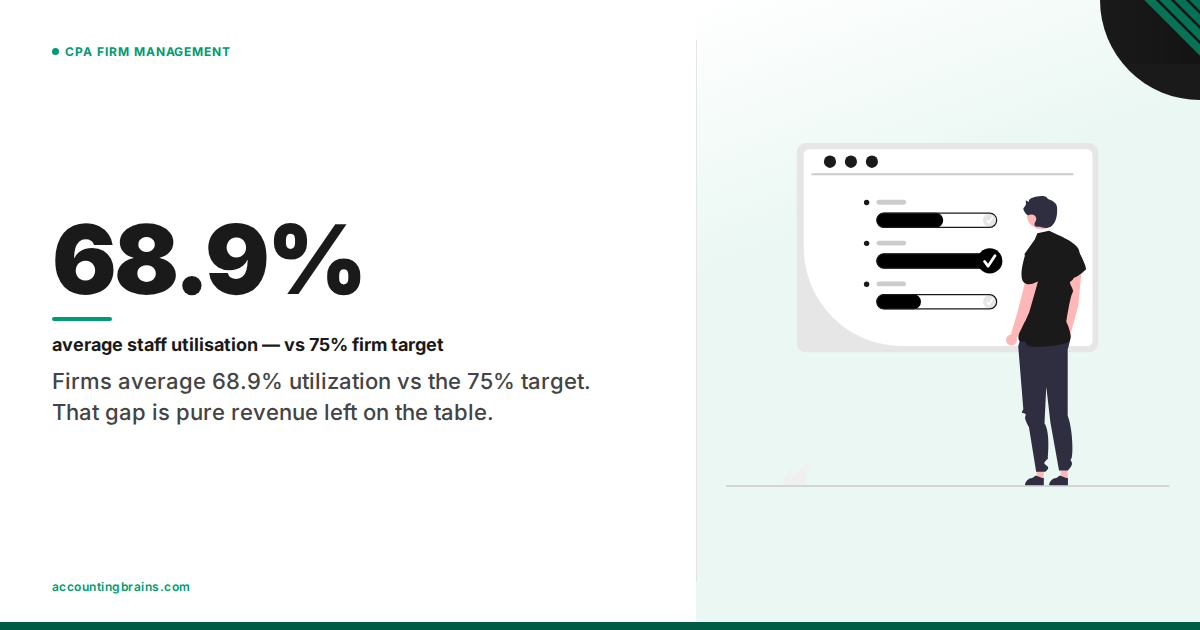
The current industry average utilization rate is 68.9% (Service Performance Insight, 2025) — already 6 points below the 75% benchmark.
Put that gap in concrete terms. For a firm billing at $200/hour with 50 professional staff, each utilization point represents approximately $200,000 in annual revenue. A 6-point gap is over $1 million in unrealized revenue per year — not from losing clients or poor pricing, but from time that exists and isn't being captured in billable output.
The gap between the 75% target and the 68.9% reality is the single most addressable revenue opportunity most accounting firms have.
Above 80%: Where Utilization Becomes Dangerous
Here's the paradox that makes utilization optimization complex: above 80% utilization is directly linked to burnout and attrition (Runn & Mosaic, 2025).
During busy season, many firms push teams to 90%+ utilization. Some individuals hit 95%. In the short term, this looks like maximum productivity. In the medium term, it produces the post-busy-season exodus — experienced staff leaving right when the firm most needs them for the next engagement cycle.
The firms that chase high utilization through overwork are trading short-term billing for long-term capacity loss. They win one quarter and lose the next quarter's starting roster.
The sweet spot — 75% — maximizes sustainable revenue without burning out the team. Getting to 75% isn't about working people harder. It's about making sure time is allocated to the right work.
Revenue Per Person: The Right Metric
High-performing firms don't optimize by headcount. They optimize by revenue per person.
The distinction matters. Hiring more staff can grow total revenue while leaving revenue per person flat — or even declining if the new hires bring high overhead without proportional billing. True performance optimization is about maximizing what each person in your firm can deliver in billable output.
The firms that lead on revenue per person share a common strategy: they eliminate non-billable overhead from professional staff time. Administrative tasks, routine reconciliation, compliance preparation, and similar work that doesn't require professional judgment gets moved off the desk of billable professionals and handled by lower-cost resources.
AICPA MAP Survey data (2025) confirms that firms with the highest revenue per person consistently outsource or automate more of the routine work — not to cut costs, but to free professional time for work that clients actually pay premium rates for.
The Fix: Remove Non-Billable Drag
The path to closing the utilization gap is clearer than most firms acknowledge.
The primary driver of below-target utilization isn't that staff are underworked or that billing rates are too low. It's that professional staff are spending too much time on non-billable activities that should be handled differently:
- Routine bookkeeping and reconciliation that keeps senior staff tied to low-value tasks
- Compliance preparation work that requires time but not senior judgment
- Month-end close mechanics that can be systematized and handled by outsourced teams
- Administrative follow-up on routine client matters
When these activities are handled by outsourced or lower-cost resources, professional staff can direct that reclaimed time toward billable advisory and client service work — and utilization rises without working anyone harder.
Building Toward 75%
The firms that consistently hit 75% utilization don't manage their way there through better timekeeping or harder pushes during slow periods. They build delivery structures that route work to the right resources.
At Accounting Brains, we work with CPA firms and accounting practices across the US, Canada, UAE, and Australia as the outsourced team that absorbs the non-billable work that drags utilization down. Our India-based professionals handle reconciliation, month-end close mechanics, compliance preparation, and routine bookkeeping — so your professional staff can focus on the advisory, analysis, and client relationship work that fills their utilization with billable hours.
The utilization gap is a structural problem. It has a structural solution.
Ready to transform your accounting? Contact Accounting Brains
Tags:
Need Professional Accounting Help?
Our CPA team is ready to help your business succeed