SOC 2 Compliance: How Automation Cuts Costs in Half and Turns Audits Into Competitive Wins
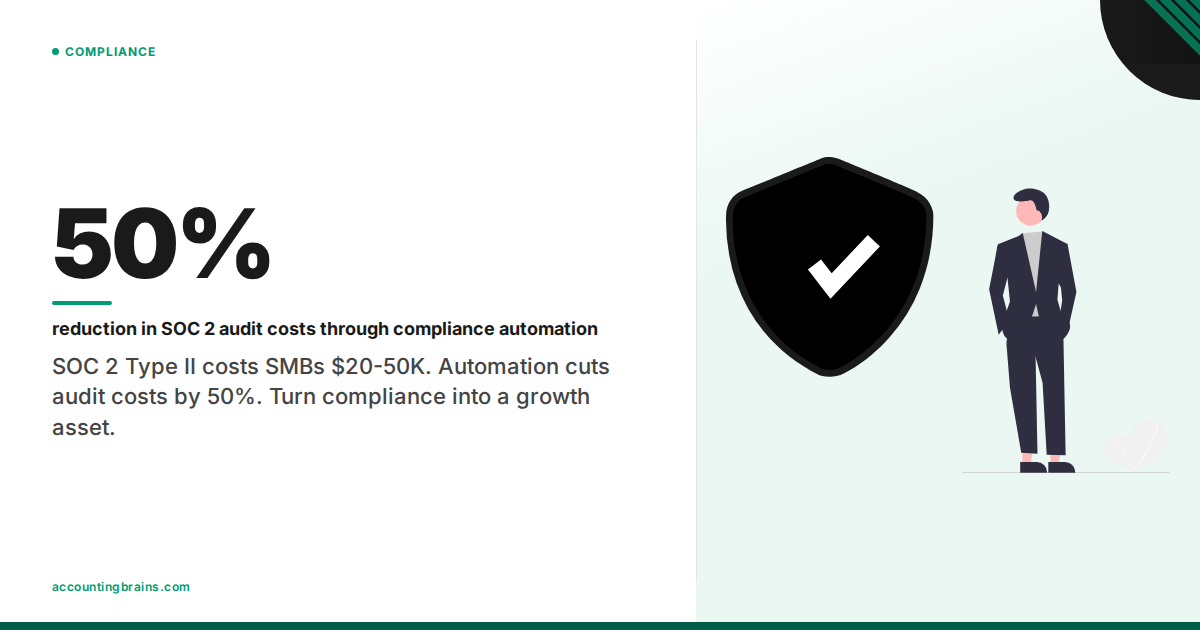
SOC 2 certification has a reputation problem: it's seen as expensive, painful, and disruptive to normal business operations. For SMBs going through their first SOC 2 audit, that reputation is often deserved.
But there's a better version of this story — one where automation slashes costs, continuous monitoring eliminates audit scrambles, and certification becomes a competitive differentiator that wins deals your competitors can't even bid on.
The difference between the painful version and the competitive-advantage version is infrastructure.
The Honest Cost Picture
SOC 2 Type II certification — the version that matters for enterprise sales, because it covers a period of operational effectiveness rather than just a point-in-time snapshot — costs SMBs $20,000 to $50,000 in auditor fees alone. That's before internal labor: the time spent documenting controls, collecting evidence, responding to auditor questions, and remediating findings.
For a 50-person company, a first SOC 2 audit typically consumes 200-400 hours of internal staff time. At fully-loaded costs, that's $30,000-$60,000 in internal labor on top of the auditor fees. A realistic all-in cost for a first SOC 2 Type II engagement can reach $80,000-$100,000 when everything is counted.
That number causes companies to delay SOC 2 until they absolutely have to pursue it — usually when a prospect requires it to sign a contract. And that delay costs more than the certification would have.
Where the Costs Actually Come From
Understanding why SOC 2 is expensive reveals where automation creates savings.
Evidence collection is the biggest labor driver. SOC 2 requires demonstrating that controls operated effectively throughout the audit period — typically 6 or 12 months. That means collecting evidence for every control, every month: access logs showing who had system access, change management records showing how code changes were approved, background check records for new employees, vendor security assessments, and hundreds of other data points.
In a traditional audit approach, this evidence is collected manually before the audit. Staff pull reports, export logs, compile spreadsheets, and gather documentation in a frantic pre-audit crunch. The process is error-prone, time-consuming, and inevitably discovers gaps that require remediation under time pressure.
Missing documentation is the single largest cause of audit delays — 40% of SOC 2 close delays trace back to evidence gaps. When an auditor asks for access logs from eight months ago and the logs weren't retained, the engagement stalls while the company documents compensating controls, seeks alternative evidence, or explains the gap.
Auditor hours are billed at $200-400 per hour. Every additional hour spent on evidence requests, clarification calls, and remediation review directly increases the audit cost. Anything that reduces auditor hours reduces cost.
What Automation Actually Does
Compliance automation platforms — Vanta, Drata, Secureframe, and similar tools — fundamentally change the SOC 2 economics by attacking costs at their source.
Continuous evidence collection is the core capability. Instead of manually collecting evidence before each audit, automation platforms continuously collect and store evidence as operations occur. Access reviews happen automatically on a scheduled basis. System configuration changes are logged and documented automatically. Vendor security assessments are tracked and renewed systematically.
When the auditor asks for evidence of control operation during month 7, it's already collected, organized, and ready to export. The audit crunch becomes an audit readiness check rather than an evidence emergency.
Automated control monitoring catches compliance gaps in real-time rather than discovering them during audit fieldwork. When a user account isn't properly offboarded within the required window, the platform flags it immediately. When a vendor's SOC 2 certification is about to expire, the platform alerts the vendor management process. Issues that would create findings during an audit get resolved before the audit starts.
Auditor evidence export packages evidence in auditor-ready formats, reducing the back-and-forth between internal teams and auditors that consumes both parties' time. Many automation platforms maintain direct integrations with audit firms, streamlining the evidence transfer process further.
The measured result: 25-50% reduction in audit costs through reduced auditor hours and reduced internal labor. For a company spending $50,000 on SOC 2, that's $12,500-$25,000 in savings — enough to fund the automation platform for multiple years.
The Year 1 ROI Calculation
Compliance automation platforms typically cost $10,000-$30,000 annually depending on company size and scope. The ROI math for Year 1:
Reduced auditor fees: 25-50% reduction on $25,000-$50,000 audit = $6,250-$25,000 saved Reduced internal labor: 40-60% reduction on 200-400 hours at $100/hour fully-loaded = $8,000-$24,000 saved Fewer remediation costs: Continuous monitoring catches issues before audit, reducing last-minute remediation spend = $5,000-$15,000 saved
Total Year 1 savings: $19,250-$64,000 against a platform cost of $10,000-$30,000. The math resolves to net positive ROI by month 8-12 for the typical SMB SOC 2 engagement.
In subsequent years, the savings compound: the audit is faster because the auditor is working with a mature, well-documented control environment rather than reviewing a first-year certification. Evidence is already collected. The evidence gap problem is eliminated. Renewal audits typically cost 40-60% of initial certification.
SOC 2 as Competitive Advantage
The strategic case for SOC 2 goes beyond cost management. Enterprise clients increasingly require SOC 2 certification as a condition of doing business — particularly for software vendors, professional services firms handling sensitive data, and outsourcing partners.
A firm with SOC 2 certification can compete for enterprise contracts that a non-certified firm can't even bid on. When a Fortune 500 company is selecting an accounting outsourcing partner, bookkeeping software, or financial services vendor, SOC 2 is often a threshold requirement in the RFP.
The competitive dynamic becomes compelling when you calculate the deal value of contracts won versus the certification cost. A single enterprise contract worth $200,000 annually that requires SOC 2 certification pays for the entire certification investment before the end of the contract's first month.
For accounting firms and GDCs specifically, SOC 2 certification signals something important to enterprise clients: structured information security, documented access controls, regular security reviews, and the operational discipline that large organizations require from their vendors. In the context of handling sensitive financial data for clients across multiple jurisdictions, that signal matters.
Getting Audit-Ready Efficiently
The fastest path to SOC 2 certification for SMBs combines three elements:
Start with a readiness assessment. Before engaging auditors, understand where your controls are strong and where they have gaps. A gap assessment identifies the specific control areas that need remediation before the audit period begins. Addressing gaps before the audit starts — rather than during fieldwork — is dramatically less expensive.
Implement automation before the audit period. If you're pursuing a 6-month SOC 2 Type II audit, implement continuous monitoring automation at least 6 months before you expect to start the audit. The evidence collection from those months becomes your audit-ready documentation.
Select an auditor experienced with automation platform integrations. Some audit firms have built workflows specifically for clients using compliance automation platforms. The efficiency gains from those integrations — particularly for evidence transfer — meaningfully reduce audit hours.
The Accounting Firm Perspective
For accounting firms and outsourced accounting providers, SOC 2 certification is increasingly a baseline client expectation. Clients trusting their financial data to an outsourced accounting partner want assurance that the partner's systems, access controls, and data handling practices meet professional security standards.
SOC 2 provides that assurance in a standardized, auditable format. For India-based GDCs serving US, Canadian, UAE, and Australian clients, SOC 2 certification specifically addresses the security concerns that arise when sensitive client financial data crosses borders and resides in geographically distributed systems.
Compliance doesn't have to cost a fortune. It does have to be structured, systematic, and maintained continuously. The firms that treat SOC 2 as infrastructure — rather than a one-time project — get certified faster, maintain compliance cheaper, and use the certification as a growth tool rather than an operational burden.
Ready to transform your accounting? Contact Accounting Brains
Tags:
Need Professional Accounting Help?
Our CPA team is ready to help your business succeed