SME Finance Goes Digital: 78% Already Use Digital-Only Banking — Is Your Accounting Practice Keeping Up?
The branch visit is dead for business banking. More than three-quarters of small and mid-sized businesses have already moved to digital-only banking — and the accounting practices that serve them haven't kept pace.
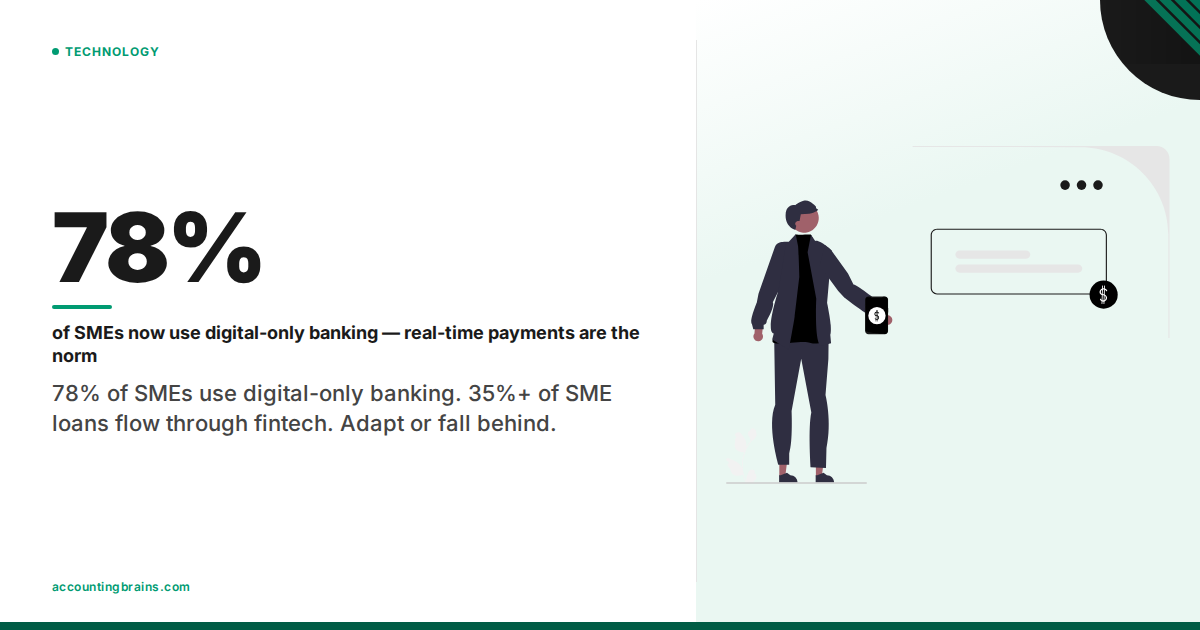
78% of SMEs now use digital-only banking as their primary financial infrastructure, according to CoinLaw's 2025 research. Mobile-first interfaces, API-based integrations, real-time transaction data, and 24/7 access have replaced the relationship banking model that defined business finance for decades.
The accounting implication is significant: the way your clients manage money has fundamentally changed. The accounting practices that still expect CSV exports, manual bank reconciliations, and periodic statement downloads are serving their clients with yesterday's infrastructure.
The Scale of the Shift
The SME banking market represents a $1.72 trillion opportunity, and every major financial institution is competing for it with digital-first offerings. Traditional banks, challenger banks, fintech platforms, and neobanks have all converged on the same insight: business owners want real-time data, seamless integrations, and frictionless digital experiences.
The competitive pressure has delivered remarkable capability improvements for SMEs:
Real-time transaction visibility means business owners see payments the moment they clear — not when the bank statement generates at month-end. Cash flow decisions happen on current information rather than lagged data.
API integrations with accounting software, payroll systems, and ERP platforms mean financial data flows automatically between systems. The manual data entry that consumed bookkeeping hours is being automated at the banking infrastructure level.
Automated categorization and reconciliation means many transactions match and categorize themselves before a human reviews them. What used to require dedicated bookkeeping time increasingly happens in the background.
Fintech Lending Changed the Credit Picture
It's not just banking operations that have gone digital. The credit market for SMEs has been transformed by fintech platforms.
More than 35% of SME loans now originate through fintech lending platforms — not traditional banks. The implications for cash flow management and financial planning are significant. Fintech lenders use real-time business performance data to make credit decisions: current bank balances, payment processing volumes, accounts receivable aging, and growth trajectory. The 90-day-old financial statements that sufficed for bank loan applications are irrelevant to fintech underwriting models.
This creates a new requirement for SMEs: maintaining clean, current, real-time financial records isn't just good practice — it directly affects their borrowing capacity and terms. Businesses with messy, delayed books that can't demonstrate real-time financial health are disadvantaged in the fintech lending market even if their underlying fundamentals are strong.
Accounting practices that help clients maintain real-time financial clarity are delivering a competitive advantage that goes beyond compliance — they're improving their clients' access to capital.
Real-Time Payments: The Infrastructure Shift
The payment rails that move money between businesses are undergoing their own transformation. RTP (Real-Time Payments) and FedNow are moving from early adoption to standard expectation. Same-day settlement, instant reconciliation, and 24/7 payment availability are becoming the baseline — not premium features.
For accounting practices, real-time payments change the reconciliation workflow significantly:
In a same-day settlement environment, payments that appear in a bank account can be reconciled the same day they're initiated. The "float" in traditional payment systems — where checks and ACH transfers create multi-day reconciliation lags — is compressed to hours or eliminated entirely. Month-end reconciliation becomes less intensive because daily reconciliation becomes feasible and automated.
The practical effect: accounting workflows designed around batch processing and periodic reconciliation cycles need to evolve toward continuous, real-time processing. The clients already operating on real-time payment infrastructure are experiencing the disconnect when their accounting practice operates on a different timeline.
Across the USA, Canada, UAE, and Australia
The digital banking transformation isn't uniform across jurisdictions, and accounting practices serving multi-country clients need to understand the variation:
United States: FedNow and RTP are expanding adoption, with major banks integrating real-time capabilities. Open banking regulations are advancing but remain fragmented. Fintech lending is the most mature and competitive market globally.
Canada: The Real-Time Rail (RTR) implementation has accelerated digital payments. Canadian Open Banking framework is more structured than the US approach. Canadian SMEs have adopted digital banking at rates comparable to the US, with strong use of integrated accounting platforms.
UAE: Dubai Financial Services Authority has created a progressive fintech regulatory environment. UAE businesses have adopted digital banking rapidly, with significant use of cross-border payment platforms given the international nature of UAE commerce. Currency management and cross-border reconciliation are significant considerations for accounting practices serving UAE clients.
Australia: The New Payments Platform (NPP) delivered real-time payments capability, and Open Banking (Consumer Data Right) creates API access to banking data that's more formalized than comparable US frameworks. Australian SMEs have high cloud accounting adoption rates, with Xero dominant in the market.
For accounting practices serving clients across these jurisdictions, digital banking integration isn't optional — it's how the clients actually operate. Practices that don't have workflows for real-time bank feeds, API-based reconciliation, and digital-native transaction management are adding friction to their clients' operations.
The Post-Tax Season Modernization Window
Tax season is when accounting practices are fully consumed by current-year work. Post-tax season — now — is when modernization happens.
The gap between how clients manage their finances (real-time, digital, API-integrated) and how many accounting practices process that data (periodic, manual, file-based) creates unnecessary friction, delays, and error risk. Each CSV import is a potential data integrity issue. Each manual bank reconciliation is time that automated bank feeds eliminate. Each period-end close that requires manual data assembly is work that integrated systems handle automatically.
The practices that will grow in the 2025-2030 period are the ones that match the speed of modern business banking. The practices still operating on infrastructure designed for check-based banking and desktop accounting software face an increasing capability gap with every product cycle.
What Modern Accounting Infrastructure Looks Like
The accounting practice aligned with digital banking reality has a few defining characteristics:
Bank feed integration with real-time transaction data flowing automatically into the accounting system. No CSV exports. No manual imports. Transactions appear in the accounting system when they appear in the bank.
API-based payroll and payment integration that eliminates duplicate data entry between banking, payroll, and accounting systems.
Real-time reconciliation workflows that process transactions as they occur rather than in monthly batches.
Digital document management that captures receipts, invoices, and supporting documents electronically at the point of transaction rather than collecting paper at month-end.
Cloud-based access that matches the anywhere-access model that digital banking already delivers.
Your clients have already upgraded their financial infrastructure. The question is whether your accounting practice has kept pace with how they actually manage money — or whether you're still asking them to operate on your timeline instead of theirs.
Ready to transform your accounting? Contact Accounting Brains
Tags:
Need Professional Accounting Help?
Our CPA team is ready to help your business succeed