Revenue Per Partner Is Up — But Only for CPA Firms That Optimize the Right Way
Accounting firm revenue is growing. Partner compensation is rising. The profession is, by aggregate measures, more profitable than it was five years ago.
But when you look at who is capturing those gains, a clear picture emerges: the growth isn't equally distributed. The firms at the top are pulling away from average firms at an accelerating rate — and the variable that predicts where a firm lands isn't firm size, market, or specialization. It's operational efficiency.
The Profession Is Growing — Unevenly
Median firm revenue growth hit 6.7% across the accounting profession in 2025 (AICPA MAP Survey, 2025). That's a healthy number by any measure — nearly double the inflation rate, solidly above GDP growth.
But median means half of firms are above this number and half are below. The firms at the top of the distribution aren't growing at 6.7%. They're growing at 15%, 20%, or more. And the firms at the bottom are barely holding flat.
The top firms aren't succeeding because they have better clients, better markets, or better staff. They've built operational models that convert staff time into partner income at fundamentally different rates.
Partner Compensation Is Climbing — If You've Optimized
Equity partner compensation increased 10.2% in the most recent reporting period (AICPA MAP Survey, 2025) — a significant jump that reflects the value premium being captured by optimized firms.
Partners at these firms are earning more not primarily because billing rates went up (they did, modestly), but because the revenue model itself has improved. More billable time. Less non-billable overhead. Higher-value services. More efficient delivery.
The 10.2% increase is a profession-wide average. At the firms driving the optimization, the actual improvement is considerably larger.
The Income Per Partner Gap: $753K vs $376K
The most dramatic illustration of the efficiency differential is income per partner by firm size.
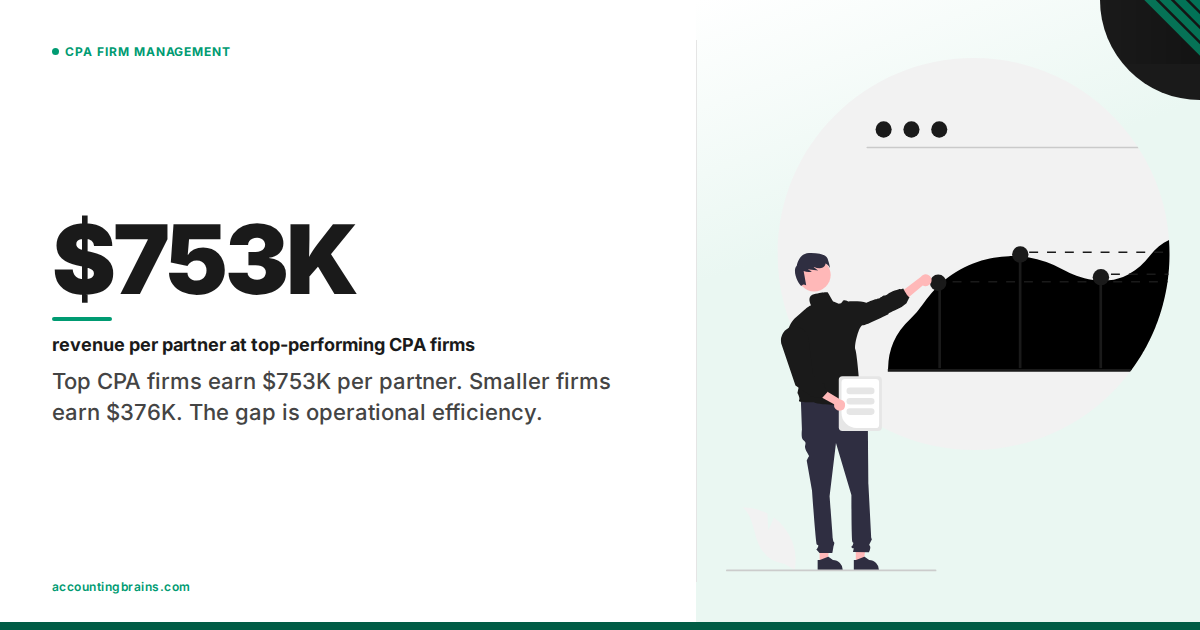
Partners at firms over $20M in revenue earn $753,000 in income per partner (Rosenberg MAP Survey, 2025). Partners at firms under $2M in revenue earn $376,000 — half as much.
This gap isn't primarily about scale advantages in billing rates or client quality. The largest accounting firms don't necessarily serve clients who are twice as valuable per engagement hour. The gap is about how efficiently firms convert their professional time into income.
Large firms that have achieved this income level share characteristic structural decisions: they outsource more routine work, they automate more of the process-intensive activities, and they focus partner time on the highest-value client interactions that command premium fees and build ongoing relationships.
Net Partner Income Growing: 11.9% Over Two Years
The income per partner story gets even clearer when you look at net remaining — what partners actually take home after firm expenses.
Net remaining per partner grew 11.9% from 2022 to 2024 (Rosenberg MAP Survey, 2025). That's real take-home compensation growth driven by genuine operational improvement, not just revenue growth that gets absorbed by higher costs.
The firms that achieved this growth did so by improving the ratio of revenue generated to expenses required to generate it. They earned more per professional, spent less on routine processing, and retained more of what they generated.
Efficiency, Not Scale, Is the Differentiator
The critical insight is that income per partner isn't primarily a function of firm size. It's a function of how firms allocate professional time.
The highest-income partnerships don't necessarily have the most clients or the highest billing rates. They have the most efficient delivery models — where partner time is protected for client strategy, business development, and complex advisory work, while routine compliance and processing work is handled by lower-cost resources.
This is the model: outsource compliance and transaction processing, free partners for advisory, capture the premium fees that advisory commands.
A partner spending 40% of their time reviewing routine bookkeeping work versus spending 40% of their time on advisory strategy represents a massive income differential. The first earns roughly what a senior manager earns for that time. The second earns what a strategic advisor earns — often 2–3x the rate.
Building the Model That Closes the Gap
The path to higher income per partner starts with an honest assessment of how partner time is currently allocated.
Questions worth asking:
- What percentage of partner time goes to work that a senior manager or outsourced team could handle?
- What's the billing rate differential between compliance review and advisory work?
- How much income is left unrealized because partners are capacity-constrained by routine work?
At Accounting Brains, we help CPA firms across the US, Canada, UAE, and Australia reclaim partner time by handling the compliance and transaction processing backbone through our India-based accounting teams. Our multi-level QC process ensures quality that matches or exceeds what partners were reviewing — freeing them for the strategic work that drives the income gap between average firms and leading firms.
The $753K income per partner number isn't reserved for the biggest firms. It's achievable by firms that build the right structure — regardless of size.
Ready to transform your accounting? Contact Accounting Brains
Tags:
Need Professional Accounting Help?
Our CPA team is ready to help your business succeed