The Real Cost of an Empty Accounting Desk: Why Unfilled Positions Hurt More Than You Think
There's a desk in your firm that's been empty longer than you're comfortable admitting. Maybe you've been covering it by redistributing work. Maybe you're in month two of a search with no qualified candidates in sight.
That empty desk isn't just an inconvenience. Every week it stays empty, it's costing your firm in ways the job posting doesn't capture.
300,000+ Have Already Left
The accounting profession has lost more than 300,000 CPAs and accountants since 2020 — a 17% decline in the workforce (SmartVault & IMA, 2025). And the losses aren't stopping: 24% of accountants still working plan to leave within the next 12 months.
This isn't a temporary disruption from pandemic-era changes. It's a sustained structural exit from the profession. Experienced professionals are leaving for tech roles, corporate finance positions, and careers with better work-life balance. Entry-level candidates are choosing fields that don't require 60-hour weeks during busy season.
The pipeline that CPA firms have always relied on — graduate hiring, lateral moves, partner-track progression — isn't refilling at the rate it's emptying. The math doesn't work in your favor, and it gets worse every year.
73 Days to Fill a CPA Role
In a tight market, time-to-hire is the most expensive metric that accounting firms don't measure carefully enough.
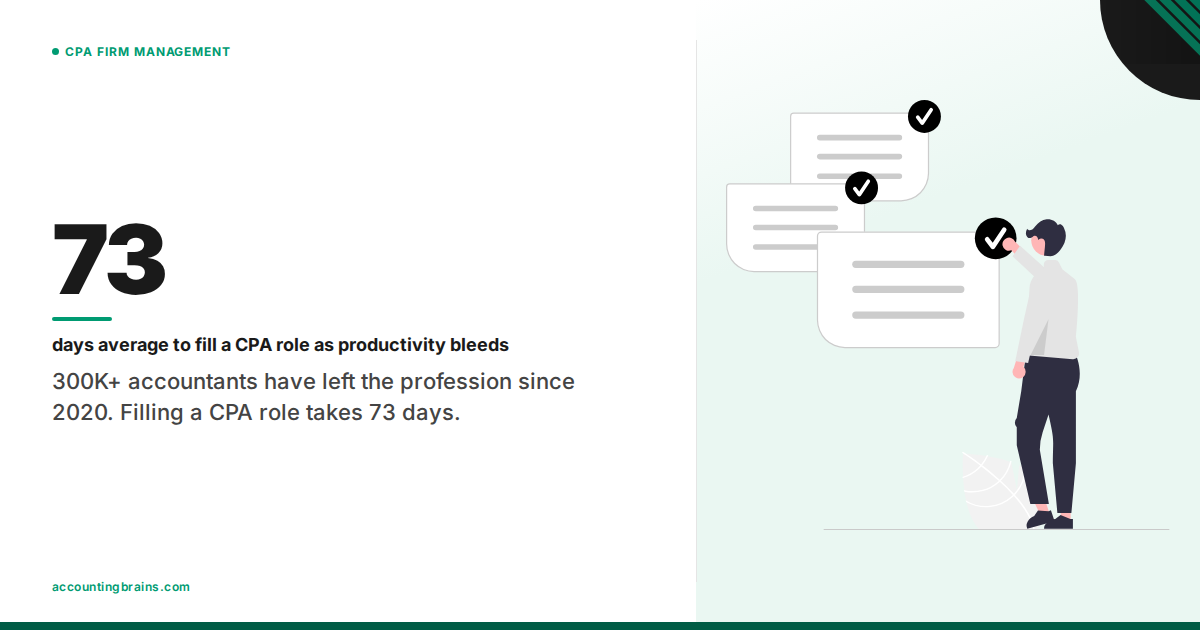
It now takes 73 days on average to fill a CPA-required role — 41% longer than filling non-CPA positions (TalentFoot Executive Recruiting, 2025). Nearly two and a half months where that position goes unfilled, where work gets redistributed, where existing staff gets stretched.
Here's what makes that number even more painful: qualified candidates in this market receive multiple offers within 10–14 days of starting their search. If your firm's hiring process involves multiple interview rounds, committee decisions, and extended offer timelines, the candidates you want have already accepted elsewhere before you've reached a decision.
The firms successfully hiring in this environment have compressed their decision-making dramatically. But even with fast processes, 73 days is the median. Some roles take much longer.
Near-Zero Availability: 1.7% Unemployment
The unemployment rate for accountants sits at 1.7% (Bureau of Labor Statistics, 2025) — against a national average of 3.8%.
Practically speaking, this means near-zero availability. Nearly everyone who is qualified and looking has already been hired. The pool of available accountants is not just small — it's actively shrinking as the profession itself contracts.
When you post an accounting position expecting a qualified candidate pool, you're not drawing from a pool. You're competing with every other firm in your market for a handful of people who are already evaluating multiple opportunities.
Empty Desks Are a Compliance Risk, Not Just a Capacity Problem
Here's the consequence that most firms don't see coming: nearly 640 U.S.-listed companies reported material weaknesses directly tied to accounting staff shortages in recent filings (SEC Filings & KPMG, 2025). 34% of all material weaknesses now cite lack of accounting resources as a contributing factor.
When staffing gaps persist, controls break down. Reviews get skipped. Reconciliations get delayed. Transactions get misclassified. The downstream consequences show up in financial statements — and sometimes in regulatory filings — long after the hiring problem first appeared.
This is the hidden risk of the open desk: it's not just a productivity gap. It's a quality and compliance gap that compounds over time.
The Market's Answer: Contract and Outsourced Models
The market has already responded to this reality.
43% of accounting managers have shifted to contract, fractional, or outsourced talent instead of waiting for full-time hires that may never come (Robert Half, 2025). Nearly half of the profession's management layer has adapted — not because they preferred it, but because the traditional full-time hiring model simply isn't delivering.
This isn't plan B. It's the new operating model.
Firms that embraced contract and outsourced talent found something unexpected: in many cases, the quality of output matched or exceeded what they were getting from full-time hires — often at a lower fully-loaded cost. Without the overhead of benefits, workspace, and management attention, outsourced teams can be deployed faster, scaled as needed, and adjusted without the complexity of employment decisions.
Building a Finance Team That Doesn't Depend on Hiring
The most resilient accounting firms in 2026 aren't the ones that hired fastest. They're the ones that built delivery structures that don't break when key people leave.
At Accounting Brains, we provide CPA firms and businesses across the US, Canada, UAE, and Australia with outsourced accounting teams that fill exactly the gap the talent market has created. Our India-based professionals — dedicated, trained, and quality-controlled — handle bookkeeping, reconciliation, payroll, AP/AR, and month-end close.
We're not a temporary staffing band-aid. We're the structural delivery capacity that lets firms operate without depending on a talent market that's already moved on.
70+ clients. 98% retention. $50M+ in financials managed. The empty desk problem doesn't have to be your problem.
Ready to transform your accounting? Contact Accounting Brains
Tags:
Need Professional Accounting Help?
Our CPA team is ready to help your business succeed