Nearshore vs Offshore Accounting: Why the Hybrid Model Wins Every Time
When businesses evaluate accounting outsourcing, they often frame it as a binary choice: offshore for maximum savings, or nearshore for easier collaboration. The firms that have done this the longest have moved past the binary.
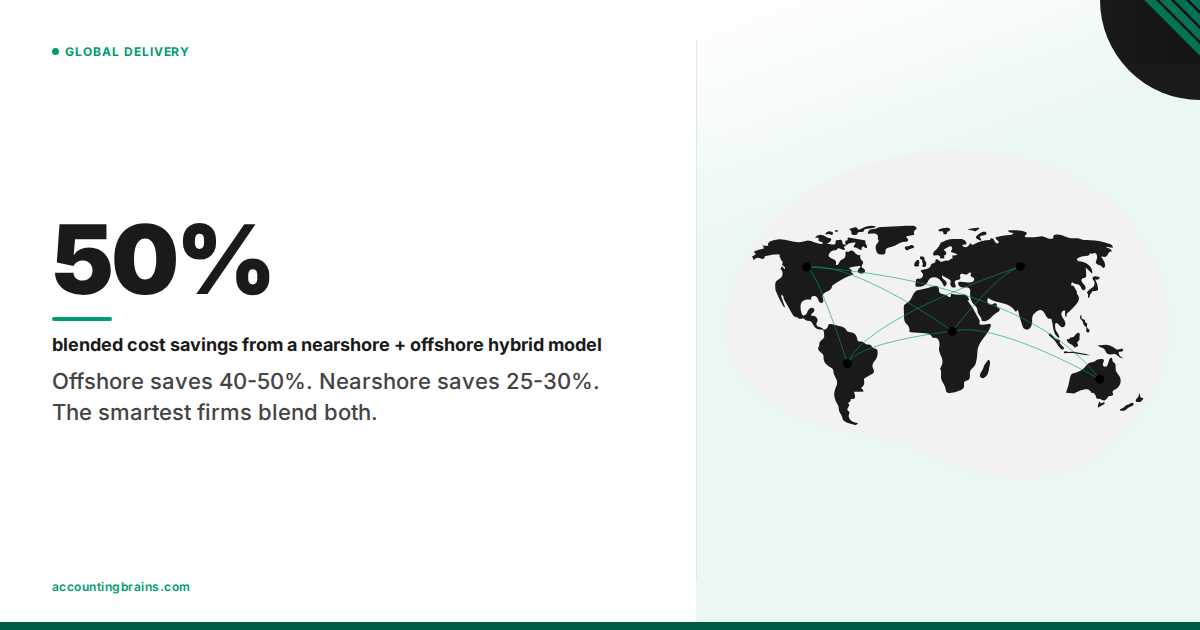
The answer isn't offshore or nearshore. It's both — strategically combined for different types of work based on what each model does best.
Offshore: The Cost Mathematics Are Compelling
The savings case for offshore accounting — primarily India-based operations — is not subtle.
Offshore accounting delivers 40–50% cost savings compared to onshore equivalents (SkaleHive/South, 2025). For compliance-intensive, high-volume work — bookkeeping, transaction processing, reconciliation, payroll calculation, AP/AR management — the offshore model provides comparable quality at dramatically lower cost.
The specific rate data confirms the scale of the arbitrage:
- General bookkeeping in India: $8–$12 per hour (Infinity Globus, 2025)
- Specialized accounting and financial analysis: $20–$30 per hour
- US equivalent for the same work: $45–$75 per hour
The arbitrage on specialized accounting is 2–3x. For high-volume bookkeeping, it's 4–6x. Applied to even modest accounting workloads, these rate differentials produce significant annual savings.
Beyond cost, offshore teams — particularly in India — bring deep professional training, English fluency, and a mature outsourcing infrastructure built over decades. The quality concern that made early offshore adopters cautious has been addressed by the industry at scale.
Nearshore: Collaboration and Time Zone Alignment
Offshore's advantages come with a practical limitation: time zone gaps.
For work that requires real-time collaboration — client calls, same-day advisory questions, rapid-turnaround requests — a significant time zone gap creates coordination friction. This is where nearshore operations — Latin America for US clients, for example — offer a structural advantage.
Nearshore accounting delivers 25–30% savings with time zone overlap and cultural proximity (SkaleHive/South, 2025). Specifically, Latin American nearshore talent saves $32,000–$44,000 per hire annually compared to US equivalents (South/RelayHC, 2025).
Same-timezone collaboration. Similar business culture. Real-time responsiveness. At 25–30% below US labor costs — a meaningful saving at scale — nearshore makes economic sense for work that requires frequent real-time interaction.
The Work Determines the Model
The hybrid framework assigns work to the delivery model best suited for it, rather than treating all accounting work as equivalent.
Offshore (India) is ideal for:
- High-volume transaction processing
- Bookkeeping and reconciliation
- Payroll processing
- AP/AR management
- Month-end close mechanics
- Tax preparation support
- Financial report generation
Nearshore (Latin America) is ideal for:
- Client-facing accounting support
- Same-timezone advisory support
- Real-time financial analysis
- CFO support with rapid turnaround needs
- Complex exception handling requiring quick back-and-forth
Onshore (domestic) is retained for:
- Senior client relationships
- Partner-level advisory
- Complex tax strategy
- Business development
- Quality oversight and escalation management
When each type of work flows to the appropriate delivery channel, you achieve maximum cost efficiency without sacrificing quality or responsiveness on the work that requires local attention.
The Firms Growing Fastest Have Already Made This Choice
The data on hybrid model adoption reflects what sophisticated accounting firms have already concluded.
25% of CPA firms already use offshore talent, with another 12% planning to start this year (AICPA National MAP Survey, 2025). Among top-performing firms, 52% have already made the move. The firms at the top of profitability rankings didn't all get there the same way — but a remarkably high proportion of them have outsourced delivery capacity in their operating model.
The competitive advantage isn't just cost. It's capacity. Firms with hybrid delivery models can absorb seasonal volume spikes without hiring. They can serve more clients without proportional headcount growth. They can maintain quality year-round without depending on a local talent market that's increasingly unavailable.
Building Your Hybrid Model
The transition to a hybrid delivery model doesn't require overhauling operations overnight. Effective transitions typically follow a progression:
Phase 1: Identify the highest-volume, most process-defined work — bookkeeping, payroll, AP/AR — and begin outsourcing to offshore teams. The QC investment here is in building the workflow, communication, and review processes that ensure quality from the start.
Phase 2: As offshore delivery becomes reliable, evaluate what client-facing or time-sensitive work would benefit from nearshore capacity. Build that relationship alongside the offshore foundation.
Phase 3: Redirect onshore professional time toward advisory, business development, and the high-value work that the freed capacity enables. This is where revenue growth follows cost efficiency.
At Accounting Brains, we operate as the offshore accounting backbone for clients across the US, Canada, UAE, and Australia. Our India-based teams provide the high-volume, process-intensive delivery that makes the hybrid model work — multi-level QC, dedicated accountants who know your clients' businesses, and 98% retention that builds institutional knowledge over time.
The choice isn't offshore or nearshore. It's designing a model where each type of work goes to where it can be delivered best.
Ready to transform your accounting? Contact Accounting Brains
Tags:
Need Professional Accounting Help?
Our CPA team is ready to help your business succeed