Month-End Close in 3 Days? Top Performers Already Do It — Here's How
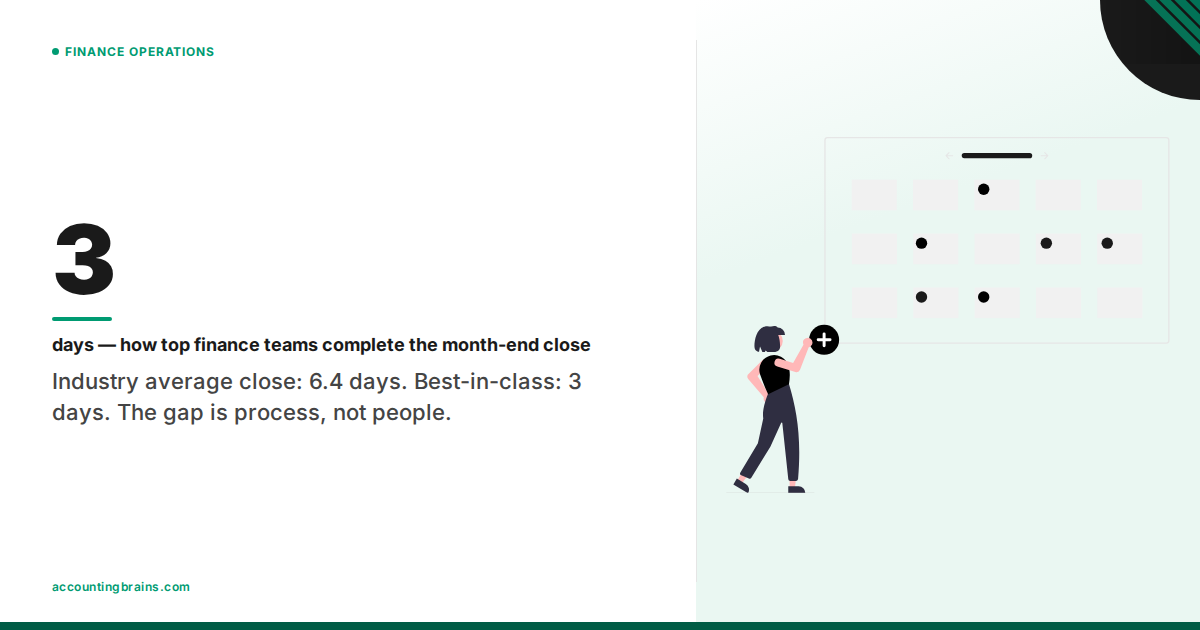
Your February close just happened. How long did it take?
If the answer is more than a week, you're leaving advisory capacity and competitive advantage on the table — every single month. The data on close cycle time is one of the clearest performance dividers in the accounting profession, and the best firms have already solved this problem in ways that most organizations haven't yet implemented.
The Industry Average Is Already Too Slow
The median month-end close takes 6.4 calendar days (APQC Benchmarks, 2025). That's the current industry average — and it's already a problem.
Six days of close time means six days every month where your finance team is locked into backward-looking activities, unable to spend time on analysis, forecasting, or advisory work that actually moves the business forward. Multiply that across a year and you've lost more than 75 days of productive finance capacity to close activities.
For small companies without process automation, the situation is considerably worse.
14 Days Without Automation
Companies without accounting automation average 14 calendar days for month-end close (Numeric, 2025).
Two full weeks. That's not just inefficient — it's a structural problem. Two weeks of close time means that by the time you have reliable financial data for the previous month, you're already halfway through the current month making decisions without complete information.
The businesses operating with 14-day close cycles aren't just slow. They're making strategic decisions with data that's perpetually half a month out of date. For fast-moving businesses in competitive markets, that timing gap has real consequences.
What Best-in-Class Looks Like: 3 Days
The top 25% of finance teams close in 4.8 days or less. Best-in-class operations with full automation reach 3 days (Ledge & Numeric, 2025).
Three calendar days. By the fourth business day of the new month, these teams have complete, reliable financial data for the month just ended. The rest of the month is available for analysis, advisory, and forward-looking work.
They're not working harder. They're not burning out their teams. They've automated the right processes and standardized the steps that don't require human judgment. The result is a close cycle that happens consistently, predictably, and without heroic effort.
The 2026 Industry Target Is Clear
The cross-industry benchmark for month-end close in 2026 is 3–5 business days (FloQast, 2026). This is now the professional standard for high-performing finance functions.
Firms that hit this target have typically implemented:
- Automated bank reconciliation — eliminating the most time-consuming manual step
- Standardized close checklists — ensuring every step happens in the right order, every time
- Outsourced routine transaction processing — so close activities focus on review and adjustment, not data entry
- Real-time GL visibility — eliminating the batch reconciliation approach that adds days to the cycle
None of these require massive technology investments. They require process design and, often, structural changes in who does what.
It's Process, Not People
The most important insight from companies that have achieved 3-day closes: they don't have bigger teams or more talented staff than their competitors.
They have better-designed processes.
The firms closing in 3 days have automated the high-volume, low-judgment work: transaction matching, bank reconciliation, intercompany eliminations. They've outsourced routine processing so that close activities are focused on review, adjustment, and analysis — not catching up on the previous month's data entry.
The firms closing in 14 days typically have the same quality staff doing the same work — they've just built a process that doesn't compress the timeline.
Every Extra Day Costs You Real Revenue
The business case for faster close goes beyond operational efficiency.
Every day your close extends beyond 3–5 days is a day your finance team can't spend on analysis, advisory, or client work. For internal finance teams, that's strategic insights delayed. For accounting firms, that's advisory capacity that could be billed — sitting on close activities instead.
For a senior accountant billing at $200/hour, a single extra day of close work represents $1,600 in foregone advisory billing. Across a team of 10 and 12 months, the extended close is a six-figure revenue drag.
Building a Faster Close Process
The path to a 3–5 day close starts with understanding where your current cycle loses time. The most common bottlenecks:
- Manual bank reconciliation — can be automated with modern accounting platforms
- Data entry backlogs at month-end — solved by moving to real-time transaction processing
- Missing documentation — eliminated through systematic close checklists
- Waiting for external data — addressed by building pre-close processes that gather this earlier
At Accounting Brains, we help businesses across the US, Canada, UAE, and Australia build close processes that consistently hit 3–5 day targets. Our India-based teams handle the high-volume transaction processing and reconciliation work that extends close cycles — so your internal team focuses on the review, analysis, and advisory work that happens after a fast, clean close.
The industry benchmark is set. The gap between your current close time and best-in-class is either competitive advantage or competitive disadvantage. The difference is process design.
Ready to transform your accounting? Contact Accounting Brains
Tags:
Need Professional Accounting Help?
Our CPA team is ready to help your business succeed