Fractional CFO Demand Surged 103%: Why the Market Is Hiring, Not Debating
The debate about whether fractional CFOs are a real strategic option has been decided by the market.
Not by opinion pieces. Not by advisory firm whitepapers. By actual hiring decisions made by thousands of businesses that evaluated the cost, the quality, and the results — and decided the traditional full-time CFO model doesn't serve most growing businesses well.
The numbers that tell this story are unambiguous.
103% Demand Increase: Two Years, Doubled
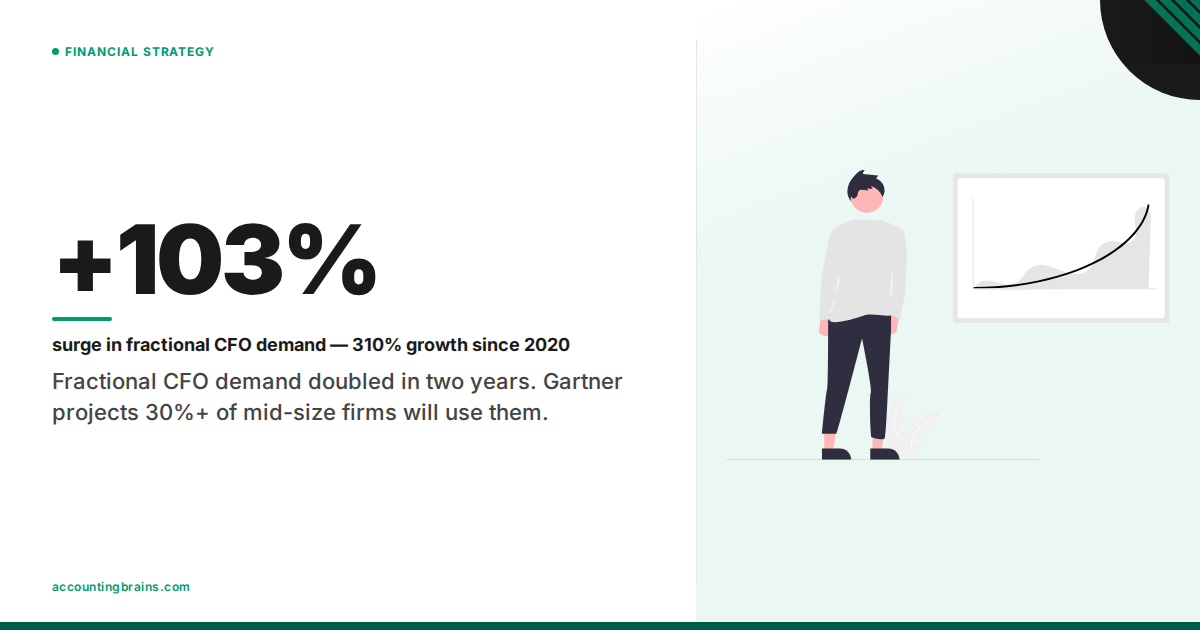
Fractional CFO demand increased 103% from 2024 to 2026 (CFO Engine, 2026) — more than doubling in two years. Since 2020, demand has surged 310%.
This isn't a linear growth trend in a niche service category. It's a fundamental shift in how businesses think about acquiring financial leadership. The growth reflects a critical mass of businesses that discovered fractional CFO arrangements deliver the strategic value they were looking for at a cost structure their finances could support.
When demand more than doubles in two years, the market has found an answer to a problem it was struggling to solve. For growing businesses, the problem was clear: they needed CFO-level strategic thinking but couldn't justify or afford a $265K+ full-time executive.
83% Already Outsource Non-Core Functions
The fractional CFO trend doesn't exist in isolation — it's part of a broader shift in how SMEs approach talent.
83% of small and mid-sized businesses already engage external firms for non-core functions (Industry Survey, 2025). Legal counsel, HR advisory, IT management, marketing — the "outsource non-core, invest in core" framework is already the operational philosophy of the majority of SMEs.
Finance leadership is increasingly recognized as a function that doesn't require full-time in-house execution to deliver full strategic value. The same thinking that led businesses to engage outside legal counsel on retainer applies to CFO services — and the market has responded accordingly.
The $265K Problem
The math behind fractional CFO adoption is straightforward but often underestimated.
A full-time CFO costs $265,000+ per year before benefits, equity, and overhead (Robert Half, 2025). For a company doing $5M, $10M, or even $20M in revenue, that salary represents 1–5% of total revenue dedicated to a single finance executive. The fully-loaded cost — add 30–40% for benefits, bonus, employer taxes, and workspace — can approach $350K–$400K annually.
A fractional CFO delivering equivalent strategic guidance — cash flow forecasting, margin analysis, board-ready financials, fundraising preparation, strategic planning support — costs $3,000–$10,000 per month. That's $36,000–$120,000 annually for the same quality of strategic thinking.
For businesses that need a CFO but can't justify the full-time cost, the fractional model doesn't feel like a compromise. It feels like obvious arithmetic.
Gartner's Projection: 30%+ Will Have Fractional Execs by 2027
The forward-looking picture is equally compelling.
Gartner projects that 30%+ of mid-size enterprises will have a fractional executive on retainer by 2027 (Gartner, 2025). Not considering it. Not evaluating it. On retainer.
This projection represents a structural shift in how professional services talent is acquired and deployed. The fractional model is migrating from a startup pragmatism to an enterprise strategy — not because enterprises can't afford full-time executives, but because fractional arrangements often deliver better value for specific functions.
What Fractional CFO Engagement Actually Delivers
The businesses that get the most from fractional CFO arrangements share clear expectations about what the engagement covers.
Strategic cash flow management: Not just knowing the current bank balance, but modeling 90-day cash positions, identifying improvement opportunities, and managing working capital actively.
Margin analysis and pricing strategy: Understanding which revenue lines actually generate profit, which clients or products have the best economics, and where to focus growth efforts.
Board and investor communications: Financial storytelling that builds confidence — clean presentations, accurate projections, and the ability to answer hard questions without scrambling.
Tax and financial planning: Forward-looking tax strategy that uses the current period to minimize the next period's liability, rather than reactive compliance after the fact.
Fundraising and credit readiness: Building the financial narrative and documentation that makes capital raise conversations productive rather than painful.
The Operational Foundation Matters
Fractional CFO arrangements deliver maximum value when they're built on a foundation of accurate, timely financial data. A CFO spending engagement time reconstructing transactions or chasing missing reconciliations isn't delivering strategic value — they're doing bookkeeping at CFO prices.
At Accounting Brains, we provide the operational accounting backbone that makes fractional CFO engagements work. Our India-based teams deliver clean books, current reconciliations, timely month-end close, and organized financial data — so your fractional CFO walks in on day one with complete information and can spend every hour on strategic value.
We serve businesses across the US, Canada, UAE, and Australia. Our 70+ clients and $50M+ in managed financials reflect a model that works when the operational foundation is solid.
The market has already decided about fractional CFOs. The question for your business is whether you're participating in this shift or watching it from the outside.
Ready to transform your accounting? Contact Accounting Brains
Tags:
Need Professional Accounting Help?
Our CPA team is ready to help your business succeed