The 75% CPA Retirement Wave: Why Accounting Firms Must Build Systems, Not Headcount
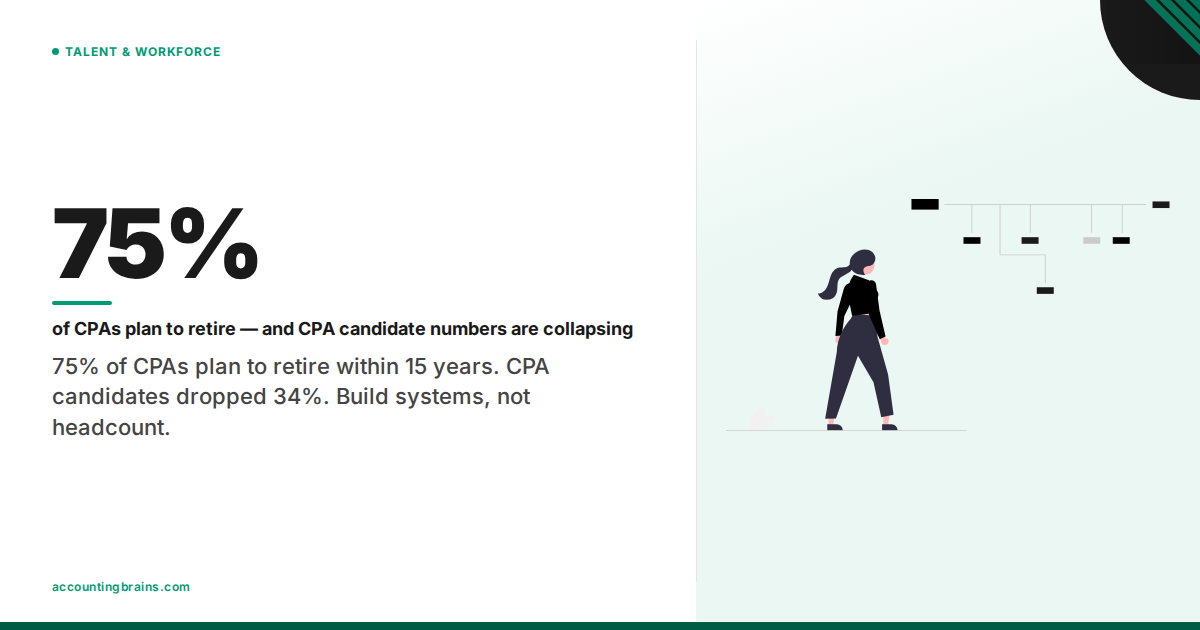
The accounting profession is facing a talent crisis that isn't coming — it's already here. Three out of four CPAs plan to retire within 15 years. One in five firms expects to lose half their staff to retirement within three years. And the replacement pipeline has effectively collapsed.
This is the math that keeps firm partners awake at night. And the firms that solve it won't be the ones who recruit hardest — they'll be the ones who build delivery systems that don't depend on headcount.
The Scale of the Problem
75% of CPAs plan to retire within the next 15 years, according to CPA Practice Advisor. That's not a gentle demographic transition — it's a structural collapse of institutional knowledge, client relationships, and capacity that's been built over decades.
The timeline is compressing in ways that make the headline number feel optimistic. 20% of firms expect to lose more than half their staff to retirement within just three years. Not fifteen years. Three years. The succession planning window isn't just narrowing — for many firms, it's already closed.
In April 2025, Baker Tilly merged with Moss Adams to create a $3.5 billion firm. This wasn't a growth merger. It was survival strategy. When firms can't replace retiring partners, they merge. The consolidation wave has begun in earnest, and it will accelerate as retirements peak.
The Pipeline Has Collapsed
The retirement wave would be manageable with a healthy incoming pipeline of new CPAs. There is no healthy incoming pipeline.
From 42,626 CPA exam candidates in 2023 to 28,082 in 2024 — a 34% drop in a single year. The AICPA 2025 Trends Report documented what practitioners had been observing anecdotally: the profession is losing its appeal to new graduates at exactly the moment it most needs them.
The reasons are well-documented: demanding exam requirements, extended education requirements (the 150-hour rule), starting salaries that lag adjacent professional tracks, and a perception of the profession as intensive but not innovative. Firms have responded with salary increases, culture investments, and educational support programs. These help at the margins. They don't change the structural math.
34% fewer candidates entering the pipeline while 75% of experienced practitioners approach retirement isn't a talent challenge. It's a structural mismatch that can't be resolved through conventional recruitment.
Why Recruitment Isn't the Solution
The instinctive response to a talent shortage is to recruit harder. The accounting industry has been doing this for five years, and the shortage has worsened every year.
Competition for qualified accounting professionals has driven salaries to levels that strain firm economics. Entry-level staff accountants in major markets command salaries that were senior accountant compensation a decade ago. Senior accountants and managers are receiving counter-offers that stretch firm compensation structures to breaking points.
More fundamentally, you can't recruit people who don't exist. When the CPA candidate pipeline drops 34% in a year, there are fewer qualified practitioners available regardless of what salary is offered. The retirement wave and the pipeline collapse are happening simultaneously, creating a supply deficit that recruitment economics can't solve.
The firms that emerge strongest from this period won't be the ones that won the salary war for scarce talent. They'll be the ones that reduced their dependence on local, credentialed headcount for the functions where it's not required.
Building Systems That Don't Retire
The retirement-resilient firm looks fundamentally different from the traditional partnership model. Instead of capacity concentrated in long-tenured partners whose retirement creates client service crises, it distributes capability across delivery systems that are independent of any individual's tenure.
Process systematization is the foundation. Work that lives in partners' heads is work that retires with partners. Work that lives in documented, systematized processes can be executed by any qualified professional. The firms investing heavily in process documentation now are building an asset that survives retirements — and that makes outsourcing, technology automation, and knowledge transfer dramatically more effective.
Outsourced capacity for core functions breaks the headcount dependency. Compliance work, bookkeeping, tax preparation, financial reporting — these functions follow established processes that can be executed by qualified professionals regardless of where they're located. For accounting firms serving the USA, Canada, UAE, and Australia, offshore and nearshore delivery models provide access to a global talent pool that isn't facing the same retirement wave.
India's accounting talent pool — 194,400 professionals dedicated to F&A outsourcing — operates on a completely different demographic curve. The retirement wave devastating North American firms hasn't hit Indian accounting talent. Firms that partner with India-based GDCs access a growing, well-trained workforce rather than a shrinking one.
Technology as a force multiplier means fewer professionals can deliver more output. AI-assisted tax preparation, automated reconciliation, cloud-based workflow management — these tools don't replace the judgment that CPAs provide, but they dramatically reduce the hours required for process-intensive work. A firm that deploys automation can maintain client capacity with fewer senior professionals.
Knowledge transfer infrastructure before retirements happen captures the institutional knowledge that walks out the door with retiring partners. Client histories, technical approaches, relationship nuances — systematically documented and transferred, this knowledge becomes a firm asset rather than a personal one.
The Client Relationship Question
The deepest concern about the retirement wave isn't capacity — it's client relationships. Long-tenured partners carry decades of client trust that isn't easily transferred.
The firms navigating this successfully are doing three things: introducing clients to successor relationships years before transitions, building client relationships with the firm brand rather than individual partners, and ensuring that the advisory quality clients receive doesn't depend on which professional delivers it.
This is where outsourced delivery models provide an unexpected advantage. When routine compliance work is handled by a systematized offshore team, partners' time concentrates on the high-value advisory relationships. Partners spend less time on work that commoditizes them and more time deepening the strategic relationships that clients value most. When they retire, there are fewer service dependencies to transfer.
The Three-Year Window
The 20% of firms expecting 50%+ retirements within three years don't have a decade to build new delivery models. They have 36 months.
The firms that will thrive — not just survive — through the retirement wave are the ones making structural decisions now: investing in outsourced delivery partnerships, systematizing processes before the knowledge holders leave, deploying technology to multiply remaining staff capacity, and rebuilding client relationships around firm capability rather than individual practitioners.
The accounting profession's retirement wave isn't a problem that can be solved. It's a structural reality that has to be managed through intelligent adaptation. Systems don't retire. Client service capability built into process and infrastructure survives any individual departure.
The firms that build those systems in the next three years will be the ones still standing — and still growing — when the wave crests.
Ready to transform your accounting? Contact Accounting Brains
Tags:
Need Professional Accounting Help?
Our CPA team is ready to help your business succeed