7.7% of Revenue Lost to Fraud — And Small Businesses Have the Least Protection
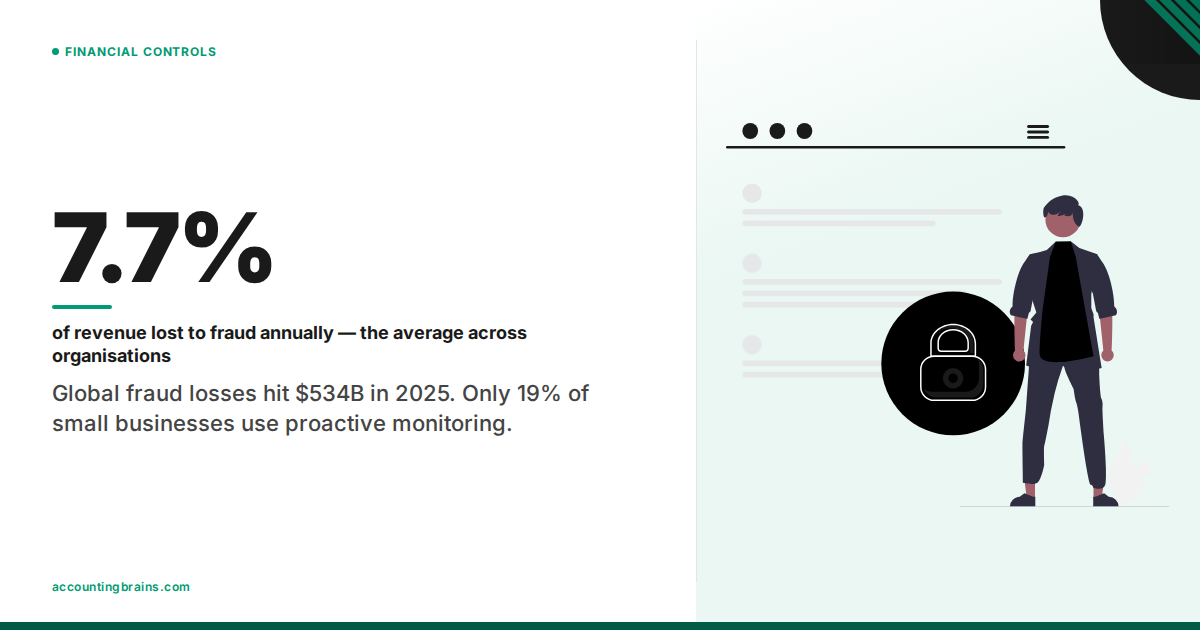
Half a trillion dollars. That's the scale of global fraud losses in 2025 — $534 billion, according to the Association of Certified Fraud Examiners. It's not an abstraction. It's a systematic failure of financial controls, disproportionately concentrated in smaller organizations with fewer defenses.
The average organization loses 7.7% of annual revenue per fraud incident. For a $10 million business, that's $770,000. For a $2 million business, that's $154,000 — often the difference between a profitable year and a crisis year. And the disturbing reality is that most of these losses happen quietly, over months or years, before anyone notices.
Where the Exposure Lives
Fraud in smaller organizations typically doesn't look like sophisticated financial crime. It looks like:
- An employee with excessive authority over both approvals and payments
- Expense reimbursements that never get cross-referenced against receipts
- Vendor payments to entities where someone in accounts payable has a personal relationship
- Payroll entries for ghost employees or inflated hours
- Purchasing card charges that accumulate below review thresholds
These aren't edge cases. They're the patterns that ACFE data consistently identifies as the most common fraud mechanisms in small and mid-sized organizations. The commonality across all of them: inadequate separation of duties and insufficient monitoring.
The Detection Technology Gap
Here's the most striking data point in the 2025 fraud landscape: AI-powered fraud detection achieves 92-98% accuracy. Human review? 24.5%.
The technology to catch fraud with near-certainty exists. Automated systems can flag duplicate payments, identify vendors with mismatched banking information, detect unusual transaction patterns, and catch expense submissions that don't match policy — in real time, before payments clear.
But only 19% of small organizations use proactive fraud monitoring. Large enterprises? 53%. The organizations most vulnerable to fraud have the least protection, while the organizations with the most resources to absorb losses are best protected.
This gap isn't about technology access — cloud-based fraud monitoring tools have become remarkably affordable. It's about awareness, prioritization, and the structural tendency of small businesses to add controls reactively after losses rather than proactively before them.
Why Small Businesses Are Most Vulnerable
The structural vulnerabilities in small businesses create fraud risk that's difficult to eliminate with policy alone:
Thin staffing means weak separation of duties. In a five-person accounting department, having one person approve purchases and a different person process payments is achievable. In a one-person bookkeeping operation, separation of duties is mathematically impossible without outsourced controls.
Management bandwidth is consumed by operations. Business owners and managers are typically too focused on revenue-generating activities to maintain rigorous oversight of financial processes. The quarterly review that would catch an anomaly gets pushed to annual. The annual audit that would surface a pattern gets skipped because it's expensive.
Familiarity breeds trust and reduces skepticism. Small organizations operate on trust. The employee who's been with the company for ten years gets the benefit of the doubt when expense patterns shift slightly. That trust, rational as it seems individually, creates systematic vulnerability.
Vendor relationships are personal. In larger organizations, vendor approval, purchase approval, and payment processing involve multiple people with no personal relationship to the vendor. In small businesses, the same person who knows the vendor personally may also control the payment process.
The Audit Season Reality
Q1 audits are when fraud surfaces — and the lag between when fraud occurred and when it's discovered adds insult to injury.
ACFE data shows that the median fraud lasts 12 months before detection. For a business losing 7.7% of revenue annually, that's a full year of losses before the pattern becomes visible. And in most small organizations, even the annual audit isn't designed to detect fraud — it's designed to verify financial statement accuracy, which is a related but different objective.
The difference between proactive monitoring and annual audit-based detection isn't just timing. It's the total amount lost. A fraud scheme caught in month two causes a fraction of the damage of one caught in month fourteen.
Building Financial Controls That Work
For smaller organizations, fraud prevention doesn't require a fraud department. It requires a structured control environment that makes fraud difficult to execute and easy to detect:
Separation of financial duties. The person who approves expenses shouldn't be the person who processes payments. The person who reconciles bank statements shouldn't be the person who records transactions. Even in small teams, these separations can be maintained with the right process design.
Automated transaction monitoring. Cloud accounting platforms increasingly include built-in anomaly detection. Transactions that deviate from established patterns, payments to new vendors above certain thresholds, and expense submissions outside policy parameters can all trigger automated review flags without human oversight of every transaction.
Regular bank statement review by ownership. The single most effective fraud prevention measure for small businesses is direct owner review of bank statements and credit card statements — not the reconciled reports, but the actual statements. Many fraud schemes survive accounting reconciliation but fail direct statement review.
Vendor verification processes. New vendor setup should require multiple approvals and verification of banking information against official sources. Vendor master file changes should be monitored as closely as payment approvals.
Anonymous reporting mechanisms. ACFE data consistently shows that tips are the most common detection method for occupational fraud. Small organizations rarely have anonymous reporting channels. Even a simple anonymous tip line — inexpensive to establish — creates a meaningful deterrent.
The AI Opportunity
The 92-98% accuracy of AI fraud detection represents an opportunity that small organizations are significantly underutilizing. Modern accounting platforms with AI-assisted monitoring can:
- Flag duplicate invoice submissions automatically
- Identify statistical anomalies in expense patterns
- Alert on payments to newly added vendors above threshold amounts
- Detect changes to employee banking information before payroll runs
- Monitor purchasing card transactions against category and merchant expectations
These capabilities are no longer enterprise-only. They're available through cloud accounting platforms at price points accessible to SMEs. The 19% adoption figure among small organizations reflects a lag in awareness rather than a genuine cost barrier.
The Multi-Country Dimension
For businesses operating across the USA, Canada, UAE, and Australia, fraud risk carries additional complexity. Regulatory environments differ, and fraud patterns vary by jurisdiction. UAE's cash-heavy business culture creates different risk profiles than Canada's digital payment infrastructure. Australian businesses face specific vulnerabilities in GST fraud and payroll tax evasion.
Multi-country operations also create complexity that fraudsters exploit. Transactions that cross borders, currency conversions that obscure true amounts, and vendor relationships in unfamiliar jurisdictions are all harder to monitor without dedicated oversight.
The solution isn't jurisdiction-specific fraud departments. It's automated monitoring that applies consistent rules across all entities and surfaces anomalies regardless of where they originate.
Prevention beats discovery. Always. The cost of building financial controls is a fraction of the cost of recovering from fraud — and that's before factoring in the damage to relationships, reputation, and team morale that comes with discovering a trusted employee has been stealing from the business.
Ready to transform your accounting? Contact Accounting Brains
Tags:
Need Professional Accounting Help?
Our CPA team is ready to help your business succeed