Bookkeeper vs Financial Analyst: One Records the Past, the Other Shapes Your Future
When your business was small, a bookkeeper was enough. They tracked every dollar in and every dollar out, kept your books clean, and made sure you were ready for tax season. They did exactly what you needed.
But businesses grow. And as they grow, the questions change.
It's no longer just "What happened last month?" It's "Why is cash tight when we're profitable on paper? Which product line is actually making us money? What should we invest in next quarter?"
Those questions require a different kind of finance professional entirely — and understanding the difference could be the most important strategic decision your business makes this year.
The Bookkeeper: Essential, But Backward-Looking
A bookkeeper earns a median salary of $49,000 in the U.S. (Bureau of Labor Statistics, 2025). They record transactions, reconcile accounts, manage payables and receivables, and keep your organization compliant. This is foundational work — absolutely critical and not optional.
But here's the honest truth: bookkeeping is inherently backward-looking. It tells you what happened. It categorizes the past. It produces reports about yesterday.
What it doesn't do is tell you what to do next.
For businesses in early stages, that's fine. Knowing what happened is enough to make reasonable decisions. But once you cross certain revenue thresholds — or face complexity in margins, multi-product lines, growth capital needs — backward-looking data isn't enough to compete.
The Financial Analyst: Strategy Built on Numbers
A financial analyst earns a median salary of $101,000 (Bureau of Labor Statistics, 2025) — more than double a bookkeeper's — because they deliver something fundamentally different: forward-looking intelligence.
A financial analyst turns your numbers into decisions. They build:
- Margin analysis — which products, services, or clients are actually profitable
- Cash flow forecasting — what your liquidity looks like 90 days from now
- Scenario modeling — what happens to your business if revenue drops 20%, or a key client leaves
- Investment recommendations — where to allocate capital for maximum return
They don't just tell you revenue is up. They tell you why it's up, whether the growth is sustainable, and what it means for your cost structure.
The $101K Question 70% of SMEs Can't Answer
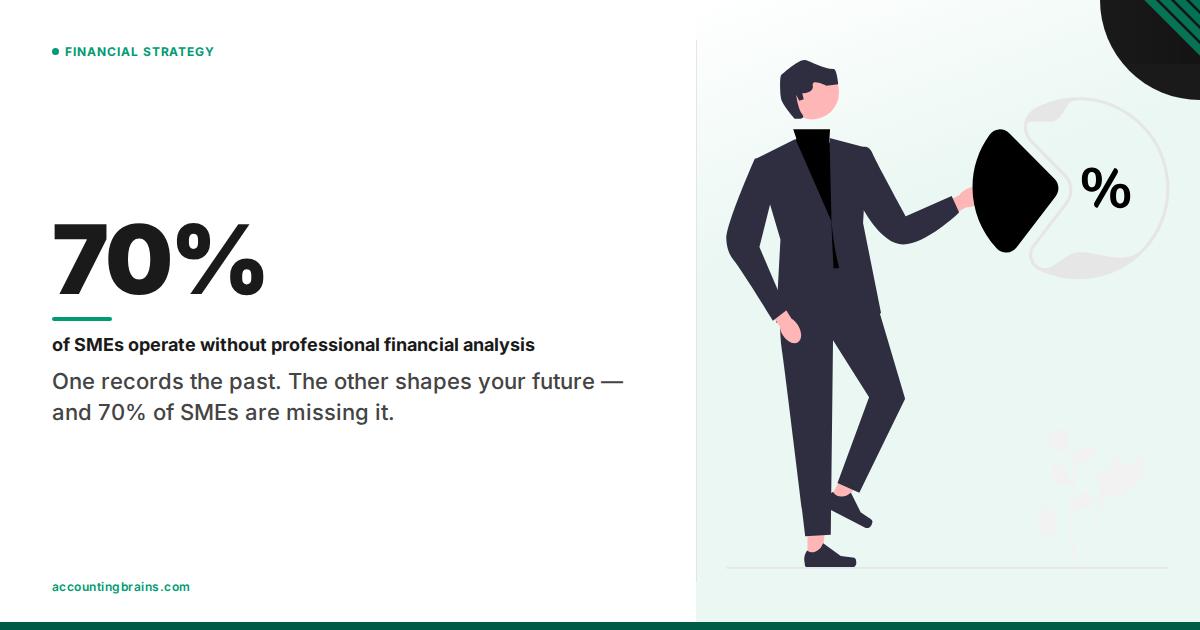
Here's a troubling reality: 70% of small and medium-sized enterprises have no professional financial analysis (Intuit QuickBooks Small Business Survey, 2025).
Seven in ten small businesses are making significant decisions — pricing, hiring, expansion, capital allocation — without anyone in the organization asking the hard strategic questions. They have someone tracking their numbers. But not someone reading their numbers.
This gap isn't a minor inconvenience. It's an existential risk.
Why the Stakes Are This High
Consider this: 82% of business failures trace back to cash flow problems (U.S. Bank Small Business Survey, 2025). Not competition. Not bad products or services. Poor cash flow management.
A bookkeeper records that you had a cash gap in March. A financial analyst sees the patterns building toward that gap in January — and gives you 90 days to act.
Those 90 days are the difference between a business problem and a business crisis. Between a correctable course and an unrecoverable one.
This is the gap that analysis closes. And it's the gap that nearly 30% of all SMEs will face in a way that threatens their survival this year.
You Don't Need to Choose — You Need Both
Here's the good news: this isn't a choice between compliance and strategy. The smartest move isn't replacing your bookkeeper. It's adding analytical firepower to your existing structure.
The data backs this up: 90% of CFOs now outsource some finance functions (Personiv CFO Survey, 2025). Why? Because building a comprehensive finance team — bookkeeper, analyst, controller, fractional CFO — doesn't require hiring all of them full-time.
The math works like this:
- A full-time senior accountant or financial analyst costs $80K–$120K fully loaded
- A fractional or outsourced finance team gives you bookkeeping, analysis, and CFO-level oversight for a fraction of that cost
- You get the full spectrum of capability — recording the past AND shaping the future — without the full-time overhead
For growing businesses doing $1M–$20M in annual revenue, this isn't a luxury. It's the most capital-efficient way to compete.
Signs You Need to Make the Move
You've outgrown the bookkeeper-only model when:
- You're making gut-feel decisions instead of data-driven ones
- Cash is tight even when revenue is growing — a classic sign of unmanaged working capital
- You can't answer basic questions like "What's our customer acquisition cost?" or "Which service line has the best margin?"
- Investors or lenders are asking for projections you can't produce
- Tax season feels like a crisis every year rather than a routine event
If any of these sound familiar, you're not behind on bookkeeping. You're behind on financial strategy.
Building the Right Structure
The most efficient finance function for an SME in 2026 looks like this:
- Bookkeeping (outsourced or in-house): Clean books, compliance, month-end close
- Financial analysis (fractional): Margin analysis, forecasting, KPI tracking
- CFO oversight (fractional): Strategy, capital allocation, board-ready financials
When structured this way, you get complete coverage at 40–60% less cost than building the team in-house. You're not choosing between compliance and strategy — you're funding both.
At Accounting Brains, we help businesses across the US, Canada, UAE, and Australia build exactly this structure. Our India-based teams provide bookkeeping and analysis that rivals what you'd pay three times more for locally — with multi-level quality control and dedicated accountants who understand your business.
The businesses that survive and scale aren't the ones with the biggest budgets. They're the ones who used their finance function strategically.
Ready to transform your accounting? Contact Accounting Brains
Tags:
Need Professional Accounting Help?
Our CPA team is ready to help your business succeed