AP Automation: How to Achieve 300% ROI in Year One by Fixing Your Invoice Processing
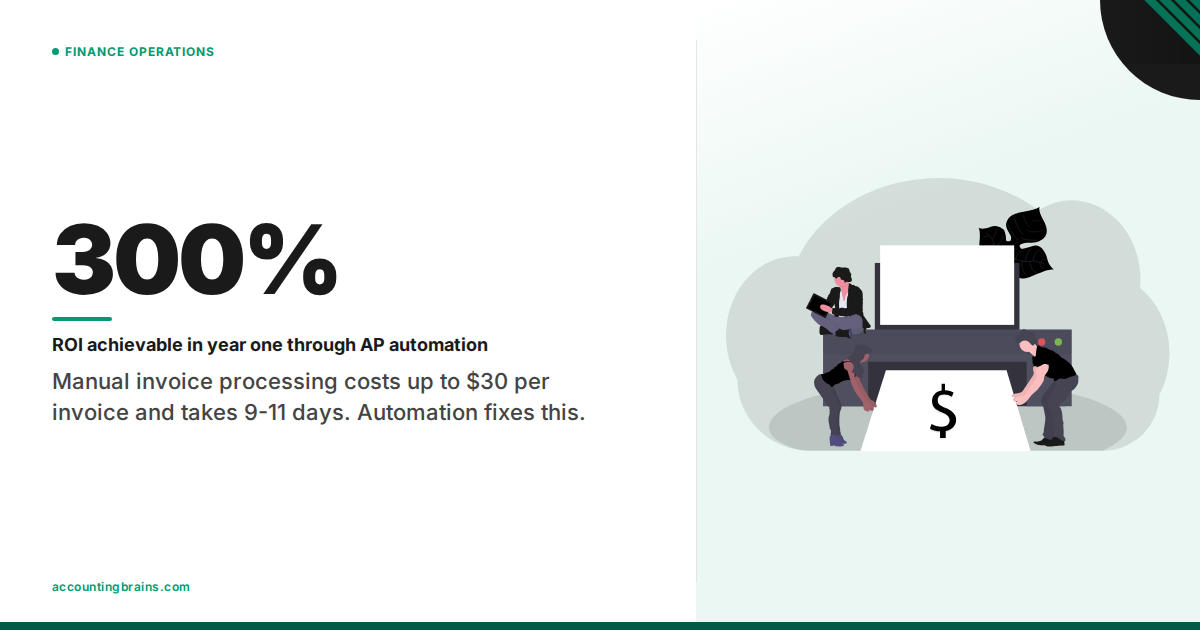
Accounts payable is one of the most overlooked optimization opportunities in business finance. It's invisible when it works, expensive when it doesn't, and most organizations are paying far more than they realize for a process that exists in a completely automatable form.
The gap between manual and automated AP isn't marginal. It's one of the largest per-unit cost differentials in modern finance operations — and the ROI of closing it is measurable, fast, and often dramatic.
$12–$30 Per Invoice: The True Cost of Manual Processing
Every invoice your team processes manually carries a hidden cost that most finance leaders underestimate.
Manual invoice processing costs $12–$30 per invoice (Corpay & NetSuite, 2025). That's not the payment amount — that's the operational cost of receiving, reviewing, approving, and processing a single vendor invoice by hand. The cost includes data entry time, approval routing, exception handling, payment scheduling, and reconciliation.
For a business processing 500 invoices per month, that's $6,000–$15,000 every month in processing costs alone — before considering the 9–11 day average processing time, which creates its own cash flow and vendor relationship consequences.
Most organizations that run this math for the first time are surprised at the number. The costs are distributed across multiple people's time in ways that don't appear on a single line item, which is why they go unexamined.
$1–$5 Per Invoice: What Automation Delivers
Automated invoice processing costs $1–$5 per invoice (SoftCo, 2025) — a 60–80% cost reduction from the manual baseline.
The same invoice that costs $12–$30 to process manually costs a fraction of that when AI extracts the data, routing rules send it through approval workflows, and payment systems handle disbursement. Processing time drops from 9–11 days to under 48 hours.
The output is identical — vendor paid, invoice recorded, reconciliation complete. The process is radically different in cost and time.
For 500 invoices per month, the cost savings alone can run $5,500–$14,500 per month. Over 12 months, that's $66,000–$174,000 in processing cost reduction. That's real capital that stays in the business.
95% On-Time Payment Rate — Vendor Relationships Transformed
The operational improvement from AP automation extends beyond cost.
On-time payment rates jump from 70% to 95% with automation (Corpay, 2025). That 25-point improvement has cascading effects on vendor relationships, early payment discount capture, and cash flow predictability.
Late payments damage vendor relationships in ways that are difficult to quantify but easy to experience: slower fulfillment, less favorable terms, reduced goodwill when you need flexibility. In markets where supply chain relationships matter, payment reliability is a competitive factor.
Early payment discounts — often 1–2% for payment within 10 days — also become capturable with automated AP. For businesses with significant vendor spend, that 1–2% adds up to real money annually, and it requires the payment velocity that manual processing simply can't deliver consistently.
40% of AP Team Time — Freed
The human impact of AP automation is often the most valuable outcome, and the least expected.
Automation frees 40% of AP team bandwidth (HighRadius, 2025). The work that automation handles — data entry, routing, exception queuing, payment scheduling — represents nearly half of what AP teams currently do. That's not a marginal efficiency gain. It's a transformation of what your AP function can focus on.
Freed AP capacity can redirect to:
- Vendor relationship management — proactive communication instead of reactive exception handling
- Spend analysis — understanding patterns in vendor spending that create negotiation opportunities
- Cash flow optimization — coordinating AP timing with receivables and liquidity needs
- Financial analysis support — contributing to close processes and reporting
The AP team shifts from a transaction processing function to a strategic finance function. That shift is worth as much as the direct cost savings in many organizations.
3–6 Months to Full ROI
The investment case for AP automation often involves upfront technology costs and implementation effort. The payback period is faster than most finance leaders expect.
Most firms achieve full ROI in 3–6 months (SoftCo, 2025), with some high-volume implementations seeing 300–500% return in year one. The math is straightforward: cost savings + error reduction + early payment discounts + freed team capacity typically exceed total implementation costs within a single operating cycle.
Year two onward, the savings compound without proportional cost increases. The technology cost is largely fixed while the processing volume and savings continue to scale.
AP Automation in Practice
At Accounting Brains, we integrate AP automation into the accounts payable management services we provide for clients across the US, Canada, UAE, and Australia. Our approach combines technology for high-volume invoice processing with human oversight for exception handling, vendor relationship management, and quality control.
For clients who want the benefits of automated AP without building the internal capability, we manage the complete AP function — from invoice receipt through payment and reconciliation — at costs that reflect the efficiency of an automated process and the quality control of a dedicated professional team.
The businesses managing AP manually today aren't just paying more than necessary. They're leaving competitive advantages on the table: faster payments, better vendor relationships, cleaner reconciliations, and a finance team that can focus on work that actually moves the business forward.
Ready to transform your accounting? Contact Accounting Brains
Tags:
Need Professional Accounting Help?
Our CPA team is ready to help your business succeed