AI Won't Replace Your Accountant — But Accountants Without AI Will Be Replaced
The debate about AI replacing accountants was settled before most firms finished having it.
The answer is no — AI won't replace accountants. But there's a critical qualifier that every accounting firm and finance team needs to understand: accountants who don't use AI will be replaced by those who do. The competitive gap is already opening, and it's widening every quarter.
92% Already Use It — The Question Is How Well
This isn't a future technology. It's the current operational reality.
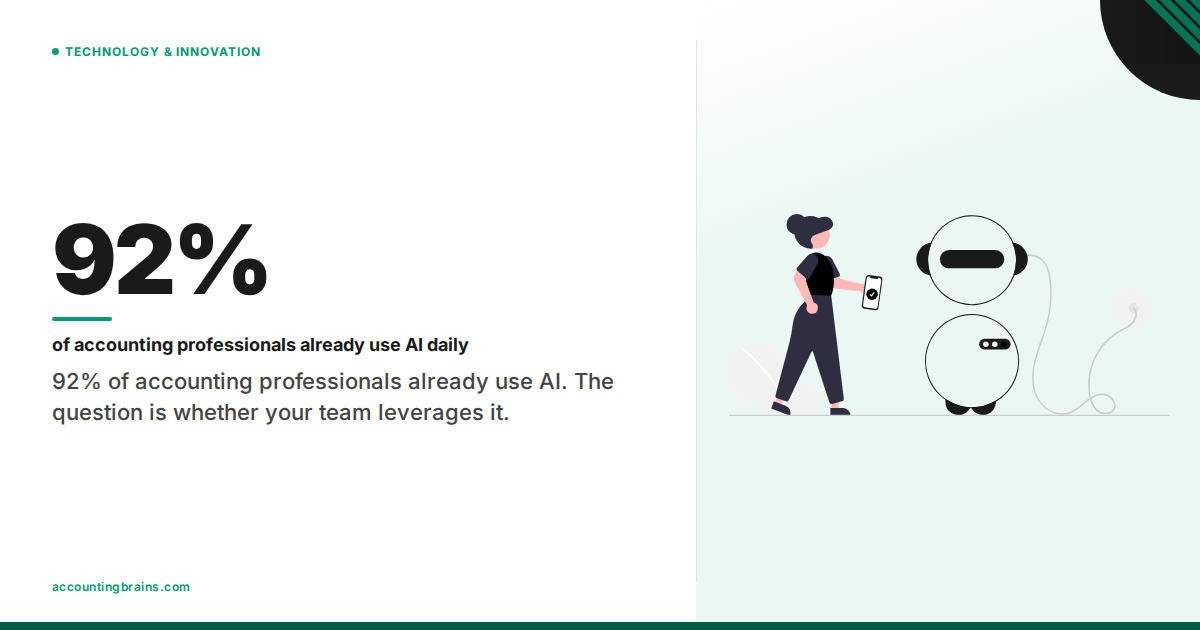
92% of accounting professionals now use AI (Karbon Accounting Report, 2025). Data entry, transaction categorization, anomaly detection, reconciliation matching — AI tools handle these tasks at scale, with speed and consistency that manual processing can't match.
If your team isn't using AI for these functions, they're spending time on work that competitors automate. That time cost compounds every month.
The question for most firms isn't whether to adopt AI. It's whether they're adopting it strategically — embedding it into workflows where it creates compounding efficiency — or using it ad-hoc in ways that don't change the underlying workload.
CFOs Have Made the Call
Finance leadership has reached a clear consensus on AI's role.
60% of CFOs call AI essential for financial transformation (L.E.K. Consulting & Gartner, 2025), up from 50% just the previous year. And critically, 79% are increasing their AI budgets in 2025.
This isn't exploration. CFOs aren't evaluating AI anymore — they're funding it. The investment decisions have been made. The question now is execution: how quickly organizations can move from "we're using some AI" to "AI is embedded in our core finance workflows."
The gap between those two states is where the competitive advantage lives.
7.5 Days Faster Month-End Close
The operational impact of AI in accounting is clearest in month-end close.
AI-assisted close cuts cycle time by 7.5 days (MIT/Stanford & HighRadius, 2025). For the average firm taking 6–10 days to close, that's not an incremental improvement — it's a fundamental transformation of what the finance team can accomplish in a month.
The numbers behind that headline are equally striking:
- 60–80 hours of manual data entry eliminated per month
- Year-end audit prep reduced from 40 hours to 4 hours
- Reconciliation errors caught by AI before they become rework
That capacity doesn't disappear — it shifts. When the close takes 2–3 days instead of 8–10, your team has the better part of a week every month to spend on analysis, advisory, and client service.
From Compliance Factory to Advisory Engine
The shift that AI enables at the firm level is profound.
93% of firms now offer advisory services (Intuit QuickBooks Survey, 2025), up from 83% the previous year. Why the jump? Because AI is doing what advisors couldn't afford to do manually — processing, categorizing, and surfacing insights from financial data at scale, freeing human expertise for the strategic conversation that follows.
79% of these firms expect advisory to grow another 38% this year. The growth trajectory tracks directly with AI adoption. As more routine work gets automated, more capacity flows toward advisory — and clients are willing to pay premium fees for that strategic guidance.
The firms that built AI workflows this year are the ones selling advisory next year. The correlation is not coincidental.
What AI Actually Does to Headcount
Here's the nuance that gets lost in the AI conversation: the impact on people isn't replacement — it's reallocation.
Less than 10% of finance functions see headcount reductions from AI (Stanford GSB & CFO Dive, 2025). What actually happens is more valuable: 8.5% of accountant time shifts from data entry toward analysis and strategy.
That's not a rounding error. That's a fundamental shift in what accountants are spending their professional lives doing. Less entering numbers. More reading them. Less processing. More advising.
The accountants who thrive in this environment aren't the ones who resisted AI — they're the ones who learned to work with it, building the analytical and strategic skills that AI can't replicate.
The AI + Human Formula
The firms pulling ahead aren't choosing between AI and human expertise. They're combining both deliberately.
AI handles the high-volume, pattern-based work: data entry, categorization, reconciliation, anomaly flagging, initial report generation. Humans handle the judgment-intensive work: interpreting anomalies, advising clients on strategy, making decisions under uncertainty, managing relationships.
Neither is sufficient without the other. AI without human oversight produces outputs without context. Human expertise without AI support is capacity-constrained and speed-limited.
The winning formula is AI for speed and scale, humans for judgment and strategy.
Building an AI-Native Finance Function
At Accounting Brains, our India-based accounting teams operate with AI-integrated workflows. We use automation for transaction processing, reconciliation, and anomaly detection — the same tools that forward-thinking CPA firms and finance departments in the US, Canada, UAE, and Australia are deploying.
This means our clients get the speed benefits of AI — faster close cycles, cleaner reconciliations, earlier anomaly detection — without having to build the AI capability themselves. They partner with a team that already runs on it.
The accounting firms and finance departments that will lead in 2026 and beyond are the ones building AI-human workflows today. The technology is proven. The competitive advantage is measurable. The only question is timing.
Ready to transform your accounting? Contact Accounting Brains
Tags:
Need Professional Accounting Help?
Our CPA team is ready to help your business succeed