AI Adoption Hit 41% in Accounting — Is Your Firm the Laggard Falling Behind?
There are two kinds of accounting firms in 2026: those that have moved on AI, and those that are still "exploring" it.
The gap between these two groups is no longer theoretical. It's operational. It shows up in close cycle times, staff utilization, error rates, and client satisfaction. The firms in the first group are building compounding advantages every week. The firms in the second group are evaluating the same technology the first group already deployed.
From 9% to 41%: An Unprecedented Adoption Curve
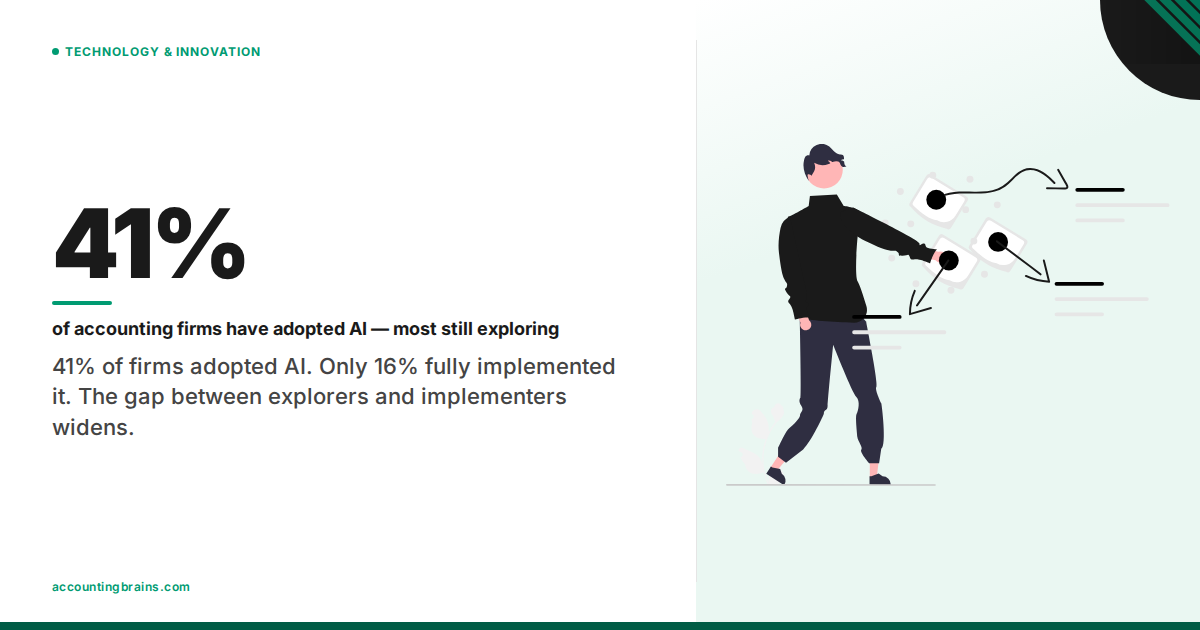
In 2024, 9% of accounting firms used AI in any meaningful way. One year later: 41% (Wolters Kluwer, 2025).
A 32-percentage-point increase in 12 months has no precedent in professional services technology adoption. This isn't a gradual market shift — it's a structural break. The accounting profession experienced a technology adoption acceleration that compressed years of normal adoption into a single operating cycle.
The firms that moved during tax season 2025 aren't just slightly more efficient. They built AI-native workflows during the highest-volume period of the year and demonstrated — with real production data — that AI delivers in accounting. They have case studies. They have trained staff. They have optimized prompts and workflows. They have a year's head start on everyone still evaluating.
63% Still "Exploring" — The Comfortable Trap
63% of accounting firms report they're "exploring" AI (CPA.com/AICPA, 2025). This number sounds encouraging until you understand what it means in practice.
Exploring AI means attending webinars. Running vendor demos. Having internal conversations about which tools to evaluate. Forming a committee to assess options. Writing an AI policy. These are all activities that take time, cost money, and produce no competitive advantage.
Meanwhile, the 41% who adopted are processing more transactions per hour. They're catching anomalies that manual review would miss. They're completing reconciliations in a fraction of the previous time. They're generating reports that used to take days in hours.
The "exploring" group isn't being prudent. They're paying an opportunity cost that accumulates with every week they don't implement.
Only 16% Have Actually Implemented
Here's the real number that matters.
Only 16% of accounting firms have fully implemented AI into their core workflows (CPA.com/AICPA, 2025). The rest either use AI ad-hoc or haven't started.
The gap between "using AI" and "implemented AI" is where competitive advantage lives. Using AI means occasionally asking a chatbot a question or trying an AI-assisted feature in existing software. Implementing AI means changing how work gets done — what steps are automated, what outputs AI generates, what quality checks AI performs, what the human role shifts to.
Implemented AI changes the unit economics of accounting work. It makes the same team capable of handling more volume. It catches errors earlier. It reduces the time between close and delivery. The 16% that have achieved genuine implementation are operating with different economics than the rest of the profession.
$10.87B: The Infrastructure Being Built Around You
Whether individual firms adopt AI or not, the infrastructure investment is massive and accelerating.
The AI-in-accounting market grows from $7.52B to $10.87B by 2026 (Mordor Intelligence, 2025). That's technology platform development, vendor investment, and capability building that happens regardless of individual firm decisions.
The accounting software your firm already uses — tax preparation platforms, GL systems, workflow tools — will have AI embedded in core features. Gartner projects 40%+ of enterprise accounting applications will include AI agents by 2026 (Gartner, 2025). The choice isn't between AI and no-AI technology. It's between firms that understand and leverage the AI in their tools versus firms that don't.
Tax Season Proved the Gap
The clearest evidence of the AI advantage came from direct comparison during peak season.
Firms with AI-integrated workflows processed returns faster. They surfaced client-specific tax optimization opportunities that manual review would have missed. They generated draft client communications in minutes instead of hours. They completed anomaly detection across large transaction sets without dedicating staff hours to manual review.
Firms without AI did the same work at the same pace as the previous year. Some did it with fewer staff than the year before, making the workload per person higher. The comparison wasn't hypothetical — it was visible in close dates, delivery turnaround, and staff satisfaction.
Partnering with AI-Native Operations
For firms that haven't built internal AI capability and are trying to close the gap quickly, one path is partnering with teams that already operate on AI-native workflows.
At Accounting Brains, our India-based accounting teams work within AI-integrated processes. We use AI for transaction categorization, reconciliation matching, anomaly detection, and report generation — not as experimental tools but as production components of our delivery workflow.
Our clients across the US, Canada, UAE, and Australia benefit from AI-driven efficiency without having to build the capability themselves. They don't have to train staff on new tools, optimize workflows through trial and error, or manage the implementation risk. They partner with a team that's already on the other side of the AI adoption curve.
The gap between AI adopters and laggards will continue to widen. The question for your firm is which side of that gap you're on.
Ready to transform your accounting? Contact Accounting Brains
Tags:
Need Professional Accounting Help?
Our CPA team is ready to help your business succeed