The 60/40 Shift: How Smart CPA Firms Are Restructuring for Profitability
There's a restructuring happening across the accounting profession — and most firms haven't finished waking up to it.
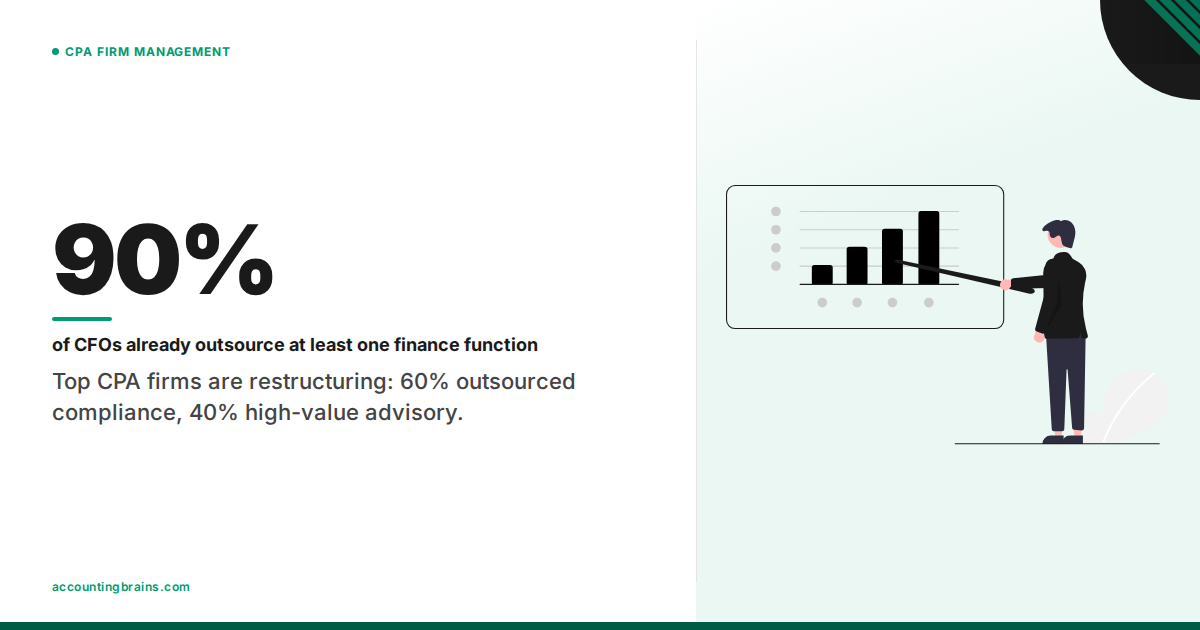
The most profitable CPA firms in North America are deliberately moving toward a new operating model: roughly 60% of routine compliance and transaction work handled by outsourced teams, with 40% of firm capacity freed for high-value advisory services. They didn't arrive at this ratio by accident. They designed it — because the math makes everything else possible.
It's Not Experimentation Anymore
For years, outsourcing in accounting was viewed with suspicion. Would clients accept it? Would quality hold up? Would regulators raise concerns?
The market has answered all of these questions decisively.
90% of CFOs now outsource some finance operations (Personiv Finance & Accounting Outlook, 2025). Nine in ten. This isn't a bold experiment by early adopters — it's the dominant operating model of sophisticated financial leadership. Routine operations — tax preparation support, bookkeeping, compliance, reconciliation — have moved to external teams at scale.
The holdouts are now in the minority. And the firms still doing everything in-house are competing against firms that have already captured the cost and capacity advantages of outsourced delivery.
A $54.8 Billion Market Built Around This Shift
The numbers behind this trend are staggering.
The F&A outsourcing market hit $54.8 billion in 2025 (Grand View Research, 2025), projected to reach $81.25 billion by 2030 at a 10–12% compound annual growth rate. This is the largest sustained growth phase the outsourcing industry has seen in a decade.
What's driving it isn't cost pressure alone. It's the realization that outsourced delivery isn't just cheaper — it's better structured for the volume and variability of accounting work. A firm that tries to handle every client at peak volume with only in-house staff has a structural mismatch between fixed capacity and variable demand.
Outsourced teams solve that mismatch by design.
Why Advisory Is the Prize — But Compliance Blocks the Door
Here's the opportunity that the 60/40 structure is designed to capture.
83% of CPA firms now offer advisory services (AICPA/CPA.com Advisory Benchmark Survey, 2025), up from 70% just two years ago. The fastest-growing firms project 99% median growth in advisory revenue over three years. Advisory isn't a future business line — it's becoming the primary value proposition of the modern accounting firm.
But you can't sell advisory if your team is buried in compliance work. Every hour a senior accountant spends on routine bookkeeping or tax preparation support is an hour they're not spending on the strategic conversations that generate advisory fees. The constraint isn't skill — it's capacity.
The 60/40 model solves this directly: outsource the compliance backbone, free the advisory capacity. Not as a cost-cutting measure. As a revenue growth strategy.
The Math Behind the Model
The financial case is straightforward.
An in-house senior accountant costs $60,000–$100,000+ fully loaded with benefits, workspace, and overhead. An outsourced team delivering equivalent output — bookkeeper, staff accountant, controller-level review — costs $30,000–$60,000 annually (GrowthForce & KMCO, 2025). That's 30–50% cost reduction with comparable output.
But the real value isn't just the cost savings on the outsourced work. It's what your existing team can do with the time that gets freed.
If a senior accountant billing at $200/hour is currently spending 40% of their time on work that an outsourced team could handle at 30% of the cost — freeing that 40% of time for advisory work creates far more revenue than the cost savings alone. The arithmetic of the 60/40 model is built on this multiplier.
The Competitive Divide
The data on who's actually making this move is telling.
25% of CPA firms already use offshore talent (AICPA National MAP Survey, 2025), with another 12% planning to start this year. Among top-performing firms — those in the highest growth and profitability tiers — 52% have already made the move.
The firms that haven't are increasingly the ones competing on price for compliance work, struggling to retain talent, and unable to build the advisory capacity that commands premium fees. The divide between high-performing firms and average firms is increasingly a divide in operating model, not client quality or staff talent.
Building Your 60/40 Structure
The transition doesn't happen overnight — and it doesn't happen without a deliberate design.
The most successful implementations we've seen follow a clear pattern:
First, identify the routine work that doesn't require local knowledge or in-person relationships. Bookkeeping, reconciliation, tax preparation support, payroll processing, AP/AR management — these are the candidates for outsourced delivery.
Second, build quality control processes that maintain standards across the outsourced relationship. This means defined workflows, regular review cycles, and clear escalation paths.
Third, redirect the freed capacity into advisory services with explicit intention. Don't just free the time — plan what your team does with it.
At Accounting Brains, we partner with CPA firms across the US, Canada, UAE, and Australia as the outsourced backbone of exactly this model. Our India-based teams handle the compliance and transaction processing work that your partners shouldn't be doing — with multi-level QC and dedicated accountants who understand your clients' industries.
The 60/40 shift is happening with or without you. The question is whether you're designing for it or reacting to it.
Ready to transform your accounting? Contact Accounting Brains
Tags:
Need Professional Accounting Help?
Our CPA team is ready to help your business succeed